

Watch this video until the very end ….
Welcome to a unique bonsai styling session with expert Lloyd Noall! In this video, Lloyd demonstrates how to combine two hardy evergreen juniper bonsai trees into a stunning twin composition. Known as the “Antler Style,” this distinctive design blends creativity and technique to craft a one-of-a-kind bonsai masterpiece.
Chinese juniper bonsai trees, often chosen for their durability and striking appearance, have spiky, needle-like foliage in their younger years. As they mature, this foliage softens into a finer, scale-like texture, giving the tree a more refined and elegant appearance. Mature Chinese junipers also develop beautifully textured bark and intricate branching patterns, making them a favourite for creating bonsai. The bark of the Chinese Juniper (Juniperus chinensis) is reddish in colour and becomes flakier with age. Thus, giving this species an aged, mature appearance.
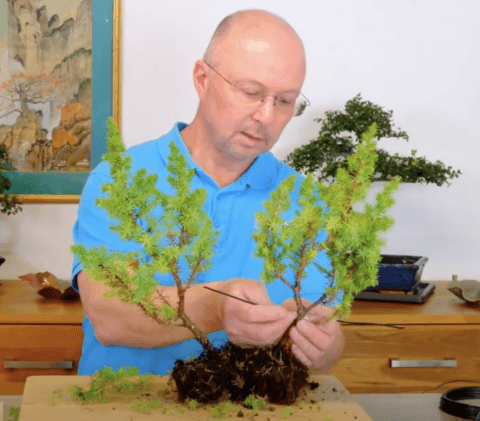
Watch as Lloyd carefully thins out the foliage, prunes with precision, wires for movement, and skillfully pots the trees together in a beautiful ceramic bonsai pot. Along the way, he shares his expert tips and insights on creating balance and harmony in multi-tree bonsai compositions.
Whether you’re a seasoned enthusiast or new to bonsai, this special project is sure to inspire your creativity and add a touch of magic to your bonsai journey. Stay tuned for the final reveal—it’s a design you won’t want to miss!
Transcription of this video about Antler-Style Twin Juniper Bonsai | Techniques of Bonsai Potting, Wiring & Pruning
Hi everyone. In this video I’m going to be concentrating on a specific style of bonsai, one which is little known really I suppose and yet it is beautiful and so I thought we would have a go of that today and you can watch and judge for yourself whether it’s a style of bonsai which you think you would like to grow.
So there are many styles of bonsai. There’s the the upright ones, formal upright (with a dead straight trunk), informal upright (a little bit of a windy or twisty S-Shaped trunk), there’s the wind swept styles, and the leaning styles and all those different styles.
The broom style of bonsai tree is quite an interesting one. The broom style has just got a straight trunk and all the branches just start at the top of that trunk and sort of radiate out around the trunk. This bonsai style is taken from the old stick brooms, you know, where they just had lots of twigs on the end of a straight handle, the broom-style. I thought today we would concentrate on a specific style of bonsai, one which is not that common but I don’t really know why. It’s got lots of history and traditions associated with it. I thought we would do that today.
Hopefully you will find it to be a bit different. I have all the bits I need, I think. I have probably forgotten something. I’ve got a nice bonsai pot, couple of little trees, this style of bonsai does require two trees. I also have some potting soil and I think that’s all we need. So, let’s get going!
Preparing the little trees for potting
The first thing I’m going to do, is to prepare the trees and I suppose you’re wondering what style of bonsai are we going to be doing. Well, this style is actually called the “Antler-Style” and it takes its origins obviously from nature. This is really important to me because actually bonsai to me, is all about nature. I love all the trees, obviously, and all the things that live on the trees and things which grow around the trees, so I particularly like this style.
We’re going to just tease out the roots, just a little bit, but not too much, these are young Chinese junipers.
Tidy up the trunks and remove unwanted branches
Now I shall get the other one done. So now this one’s done as well, and both at the same sort of stage now. Now I’m going to going to tidy up the trunks and take off any bits like this straggly bits and any old dead bits. I shall clean up the trunk line so we can see the trunk and a pair of scissors. Taking a careful look around and then just carefully snip off any twigs of shoots that I do not require for this style of bonsai. For example, I’m not going to need any branches along this bit. This section is the main part of the trunk. The trunk is the attributes that’s going to make it look like a really nice strong tree, so I’m going to just clean off all of that. Now that I have done that, we can see the trunk lines on both trees.
We’ve got to line them up because it’s important that we get the trees even and in the right places. Proportions and angles are very important in this sort of style. So I recommend that you just take a bit of time study the trees and then we can arrange them.Turn them both to get the shape that you wish to achieve. These two mini trees are both different which is not a problem, they need to be of equal size and roughly a similar shape, but they will not be identical. They just need to be balanced.
You can wire the Juniper branches to give some improved shaping
When you’re happy, and you’ve sort of settled on the kind of design you want and you know where the trunks are going to be placed, the angles you are aiming for, then we can look at the branches. And now I can see which of these branches I’m going to need to keep and which ones I can prune out.
Now this video is not really about the how to’s of doing things, about how to report and how to wire, I just really wanted to show you this lovely style of bonsai really, so I won’t go into all the details of how to do things. I think what we’ll do now is to got a little bit of wiring to do on these couple of branches here just to bring them out and give them a little bit of space around the rest of the tree.
This is an ongoing process, so the wire will stay on for a few months, until it starts to look a little bit tight and then come off. I want the two starter bonsai to be similar, but I don’t want them to be identical. The thing about nature is that everything really is uneven when you think about it. They’re not symmetrical trees, they are not even, landscapes aren’t even. Even our faces are not even, they’re not equal totally symmetrical.
Position the two trees in the pot, turning them to achieve the desired shape
After having a tidy up I will show you how to pot them. Firstly, get them into the right position, anchored in nicely, and then we can do the other. I shall do a little bit of tweaking, a little bit of tipping, and go from there. So I’ll just have a quick tidy up again.
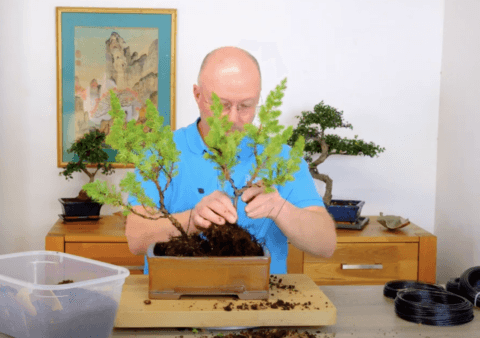
I’ve prepared the pot, got my anchor wires in, one for each tree. Now what I’m going to do is to bring the soil up quite high in the pot and I am making a little mound. Now I shall take one of the trees and break up the roots a little bit around there. I am doing this to open it up the root ball to allow the roots to spread out into the new soil. Okay let’s pop there, I won’t use the anchor wire at the moment. So we’re going to go there, but I reckon we can rise the little tree up a bit more.
Ensure the height of the bonsai within the pot is not too low
Height in the pot is quite important. I don’t want them low in the pot. I want them to stand out like they’re on a hill really. That way we can really see them, so almost accentuating the design. That’s pretty good. I can bring that anchor wire around and just try not to get any roots caught up in there, it’s not always possible. Especially with only two hands. Trying to hold the tree, hold the roots down, and twist the wire. There we go. I will just leave the wire sticking up so I can see it, because it will need tightening in a minute. I am not going to tighten it now, I want to get the other potted first.
Now’s the time we can really get the two together and get the positioning right. It’s important that we get the distance right between the two trees. Make sure the height’s right as well. You are aiming for the base of the trunks to be the same height. We’ve got to look at these angles. I am happy with that; just spinning around so I can just see.
Make sure that they’re not sort of crisscrossing or leaning one way or the other. After a little bit of a tweak,I shall put some soil in there. Using the chopstick I am working the soil around to get under that root ball down there, hold it nice and firm. I am pretty much there now, I just have the last little bit to finish off. Use the coir brush to tamp down the soil.
Trim the bonsai trees to get better proportions
Now that both the trees are well position and I the right place I shall trim down tops a little bit, and take off those dominant shoots. Now just to finish off, the finishing touches as it were, I’ve got some moss here and I’m just going to take a few little bits and I’m going to plant them on top of this hill. This is personal taste really, for me it just sort of finishes off the composition nicely. This is moss that I’ve found in the garden. It’s nice and clean you can put more around if you prefer. That’s totally up to you. So there we have it! Fantastic style of bonsai, the “Antler-Style”
Of course it’s all a bit spiky now, but gradually in time the foliage will reduce down and make lovely little foliage pads. Juvenile juniper trees are always spiky but with time the foliage softens and becomes easier to tower with.
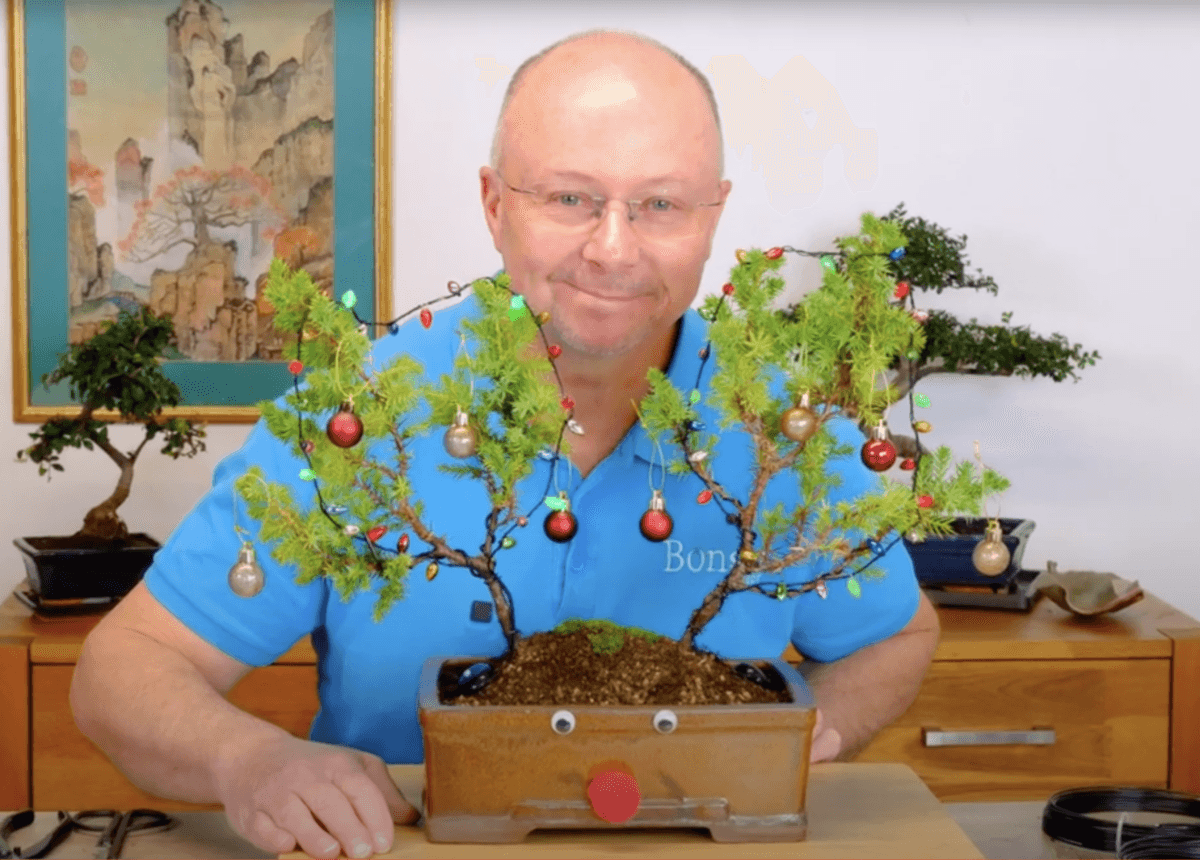
So the “Antler-Style” which gets its name from those fantastic antlers from the Rangifer Tarandus, or as we all know it – the beautiful Reindeer!
Happy Christmas everybody!
Christmas Bonsai Tree Reveal
We hope you enjoy the reveal at the end of this bonsai video and the resulting Christmas bonsai Tree. Christmas Bonsai trees make incredible gifts because they are more than just plants—they’re living art pieces that symbolise harmony, patience, and connection to nature. Each bonsai tells a unique story through its shape, age, and design, making it a deeply personal and thoughtful present. Unlike traditional gifts, bonsai trees grow and change over time, creating a meaningful, ongoing experience for the recipient. Whether displayed in a home or office, they bring a sense of tranquillity and elegance to your home. Giving a bonsai is like gifting a moment of Zen and a creative journey all in one, making it unforgettable and truly special. View our beautiful range of Christmas Bonsai Trees for Sale >



0 replies