

We are often asked how to grow a bonsai tree from a seedling or sapling. In the blog article, bonsai expert, Lloyd Noall demonstrates on a young Chinese Juniper.
I love growing bonsai trees and want to show you show to grow a Chinese Juniper bonsai tree from a young starter plant. In the world of bonsai, every tree has its own story to tell. Sometimes, it takes you in a direction you never expected. That’s exactly what happened when I started working on a Juniper bonsai with the intention of creating a windswept style. As I delved into the process, the tree revealed something different. A path that felt more natural and true to its form.
In this video, I take you through the journey of transforming this beautiful Juniper into a style it naturally “wanted” to adopt. Along the way, I share insights about listening to the tree, staying open-minded, and allowing the process to guide you. You’ll see how small adjustments, minimal wiring, and thoughtful positioning can bring out the tree’s innate beauty while honoring its potential.
From discovering the perfect trunk flare to carefully choosing the potting medium for its delicate roots, every step highlights the importance of working with the tree rather than against it. Join me as I explore how even a young bonsai like this can teach us valuable lessons about patience, creativity, and adaptability.
Whether you’re a seasoned bonsai enthusiast or just starting out, this video offers inspiration to let go of rigid plans and embrace the journey of bonsai styling. Don’t forget to like, comment, and subscribe for more bonsai adventures!
Transcription of the video about How to grow a Chinese Juniper bonsai
Hi everyone, I started working on a Juniper like this one, for this video, with the intention of creating a windswept style Bonsai where it’s sort of all flowing with the wind. But very quickly the tree said “Hey Lloyd, I really don’t want to be a windswept style” and here’s why.
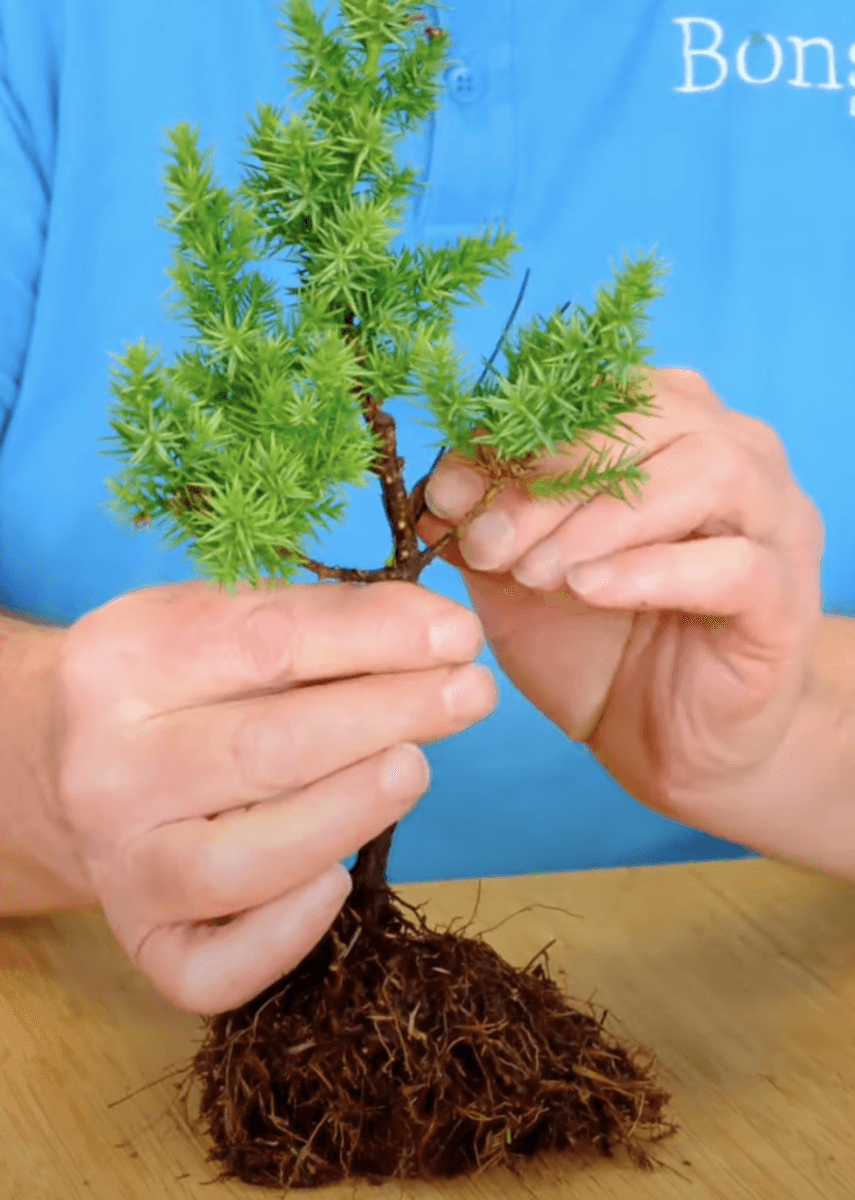
This is the Juniper that I picked out, a lovely Juniper. It has lots of nice even foliage around so I thought that would give me plenty of scope for styling. As always, I started teasing off the top soil and working my way down. I continue until I find that point of the trunk where there’s a little bit of a flare or there’s some root starting to give me that little bit of character that I want to start the Bonsai with. It was about here that I started to realise that this tree really didn’t want to be a windswept style.
Now of course the tree didn’t actually say to me “Lloyd I don’t want to be a windswept style”. What it actually did was it showed me something which made me rethink. And also reminded me of something which is important to me. This is the fact that whenever I’m working on a bonsai, doesn’t matter what stage it is, is that I always keep an open and uncluttered mind. This allows me to see things that perhaps I wouldn’t have seen if I was trying to follow a certain path. With that in mind, I just carried on working on the tree. Following the path that the tree had laid out for me and all became clear.
For small branches use 1mm bonsai wire
There was only a few larger branches then that actually needed to be removed. Thankfully not much had to be taken away and after a little bit of wiring. I think I only had to wire three branches. Obviously there’s not that many on a tree this size. But only three branches needed to be wired with some 1mm wire. Just to put some of those just three of those branches into the right position. One of the things, out of many obviously, but one of the things that I love about bonsai is that it really doesn’t matter how old the tree is. I get a lot of pleasure out of all of them. Even something as young as this little Juniper, which is only a few years old, but still gives me a lot of pleasure. It can still teach me quite a lot as well.
Positioning the bonsai is important
Getting the right position, the height, and the angle in the pot is very important as this added to the overall composition and harmony of the pot and the tree together. I decided to use quite a soft potting medium here as the roots are still quite young, still quite delicate. So this is just some soil that you would use for potting up seedlings.
I mixed it with a little bit of medium grade Akadama just to break it up a little bit. That way it’ll give something gentle for the roots to root into. Then gradually in years we can replace some of this with some heavier grade Akadama. With the tree now potted we can start to arrange the branches around the trunk. Now you can see that the true style of this bonsai is starting to show through. Bear in mind that we haven’t actually changed any of the trunk shape itself. All we have done is to remove some of the foliage. Also on a couple of branches, we have wired them a little bit, and just tweak them. We haven’t really really had to change the tree very much at all.
The Chinese Juniper has Spiky Juvenile Foliage and Soft Mature Foliage
So there we are, it’s definitely not a windswept style. It is definitely an informal upright style. So forget about what style you want the tree to be, let’s just see what it ends up as, I wonder what this one’s going to end up as.
Over the years this foliage, this juvenile spiky foliage, will settle down and form those lovely scale-like pads which really, you know, that’s the thing that the Chinese juniper is really lovely for. Size wise, the trunk will double in size over the next 5 years. This root will still be a main feature. Height may be up to here so I’ll keep it fairly small, I don’t want to grow it too big, just thicken it up a little bit, so we’ve got that to look forward to.. fantastic. I hope you really enjoyed the video and please subscribe and like and add any comments that you want to add.
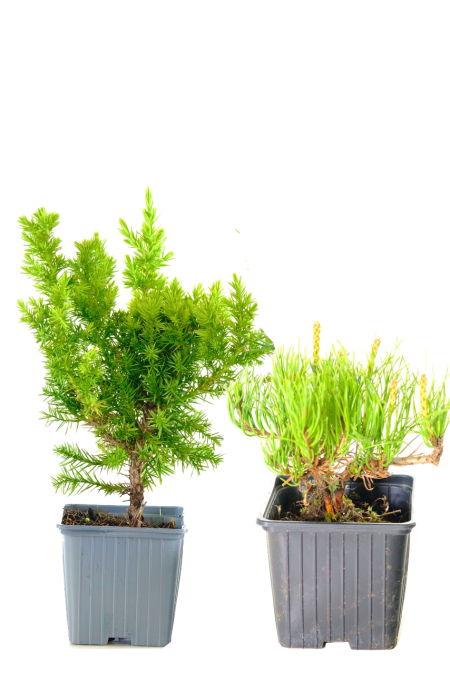
Twin Evergreen Bonsai Seedlings Pack – Chinese Juniper & Mugo Pine | Evergreen Starter Bonsai
Twin Pack of Bonsai Seedlings: Dwarf Mountain Pine and Chinese Juniper Unveil the beauty and potential of this twin pack of bonsai seedlings, featuring two of the most sought-after evergreen species: Dwarf Moutain Pine (Pinus mugo) and Chinese Juniper (Juniperus chinensis). These well-established seedlings, currently in simple plastic containers, are ready to grow and develop into magnificent bonsai trees. Dwarf Mountain Pine (Pinus mugo): Rugged Beauty and Alpine Charm for Bonsai The Dwarf Mountain Pine (Pinus mugo) is valued in bonsai for its compact, hardy nature and striking alpine character. Native to the mountainous regions of Europe, this slow-growing evergreen…
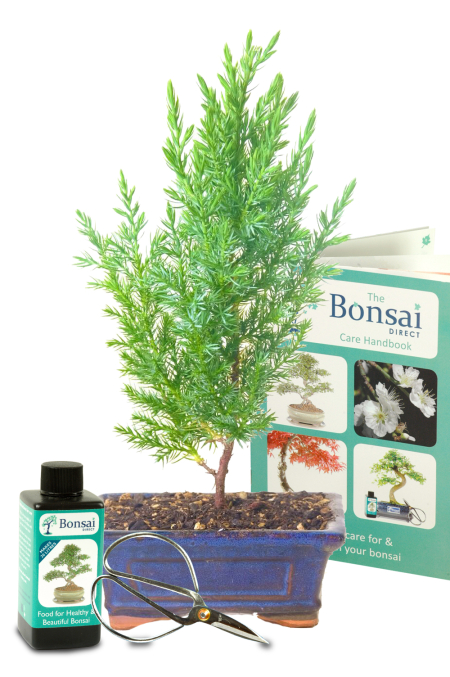
Starter Miniature Juniperus chinensis Evergreen Hardy Outdoor Bonsai Kit – Easy Care Beginners Bonsai!
A wonderful evergreen outdoor bonsai starter kit! The Juniperus chinensis, or Juniper bonsai is a hardy bonsai, perfect for beginners! The Juniperus chinensis, commonly known as the Juniper bonsai, is a stunning outdoor bonsai variety that stands out with its captivating features. These bonsai trees boast trunks with intricate structures, textured bark, and an overall enchanting appearance, making them a favourite among bonsai enthusiasts. Their hardy nature renders them an excellent choice for beginners, as they can withstand various weather conditions and are relatively easy to care for. One notable feature of the Juniper bonsai is its evergreen quality, ensuring…
So there we are, it’s definitely not a windswept style. It is definitely an informal upright style. So forget about what style you want the tree to be, let’s just see what it ends up as. I wonder what this one’s going to end up as.
Over the years this foliage, this juvenile spiky foliage, will settle down and form those lovely scale-like pads. The soft foliage pads of the Chinese Juniper is one of the things that the Chinese juniper is really lovely for. Size wise, the trunk will double in size over the next 5 years. This root will still be a main feature. Height may be up to here so I’ll keep it fairly small. I don’t want to grow it too big, just thicken it up a little bit. So we’ve got that to look forward to.. fantastic. I hope you really enjoyed the video and please subscribe and like and add any comments that you want to add.
What is Informal Upright style in Bonsai
The informal upright style, or Moyogi, is one of the most popular bonsai designs. This is because it captures the natural, unforced beauty of trees found in the wild. The trunk grows upright but with gentle curves or bends. Thus, giving it a sense of movement and character. This style creates a perfect balance between structure and spontaneity. Thereby, making it visually engaging.
Artistically, the informal upright style is admired for its versatility and storytelling. It suggests resilience and adaptation. As if the tree has weathered natural forces like wind or uneven light. Its slightly asymmetrical yet harmonious shape draws the eye. Furthermore, making it a timeless choice for bonsai growers.


0 replies