

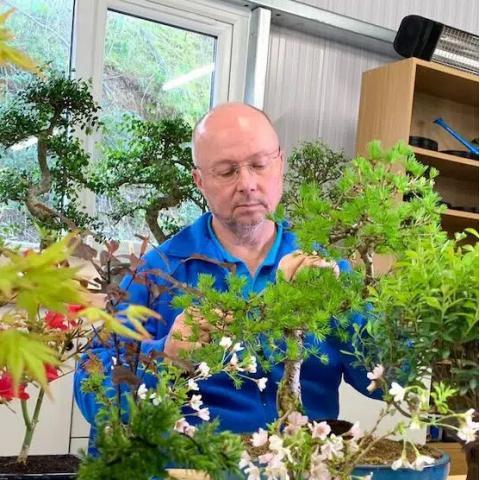
Bonsai Master Lloyd Noall has decades of professional bonsai expertise. Welcome to our detailed exploration of bonsai refinement, where today we’re looking at two popular species—the Japanese Maple (Acer palmatum) and the English, or Field Maple (Acer campestre). We’ll explore the unique qualities each tree brings to the art of bonsai and which species might be best for you. Lloyd also shows you some of the refined Maple bonsai pruning on both species.
The Japanese Maple has long been a bonsai favorite for its delicate structure and fine branching, resulting in an intricate, natural look that’s ideal for bonsai refinement. In contrast, the Field Maple, with its thicker branches and chunkier structure, brings a different aesthetic entirely, showcasing strength and resilience. Lloyd walks us through his techniques, discussing the pros and cons of each tree’s growth habits, pruning methods, and styling choices.
We’ll cover everything from the natural structure of these trees to the subtleties of shaping without wire, which helps retain the delicate, unaltered appearance of a mature bonsai. Lloyd also provides close-ups of each branch, demonstrating how careful pruning can create flow, structure, and character in each species. This is only an introduction to the pruning of each of these unique bonsai trees. In future episodes Lloyd shows us the full pruning of each of these trees.
Transcription of the Video about the Japanese & English Maple Bonsai Trees and Discussing Which Makes the Best Bonsai Tree & Demonstrates Maple Bonsai Pruning
This is a Japanese Maple (Acer palmatum) and this one is an English Maple (Acer campestre) Lloyd shows us. Does one of these make a better bonsai? Well let’s find out.
The truth is they both make fantastic Bonsai. Obviously, the Japanese maple has been used for growing bonsai for a long time. There are lots of different varieties. And they all make superb bonsai. Now, this one I call it the English maple, but it’s actually called a field maple. I’ve been growing these for quite a long time, because a long time ago I wanted to start to grow a lot of our English trees as bonsai. And this is obviously one of them. As you can see, the colours are absolutely stunning. Look at this beautiful colour. A lot of the leaves now have fallen off now as its mid November when I filmed this. But it is a beautiful colour.
Comparing the structure of the two maple species of bonsai tree
In the in the springtime, you get this beautiful bright greens, as you do on all the maples. However, they have different growing habits. The Japanese maple is a lot more delicate. You get a lot more twiggy-ness. The branches are a lot lighter and probably it is a bit easier to grow as bonsai, to be quite honest. Where as the the field maple, the Acer campestre, is quite a lot chunkier. It has much thicker branches and it doesn’t twig up quite so nicely as the Japanese maples. But that doesn’t mean to say it can’t make a fantastic bonsai.
A potted history of these two Maple Bonsai Trees
Now, I love growing these varieties. In fact, I love growing them all. But I’m going to go through the pros and cons of both species and how the pruning of each variety varies. Now, the first thing which I would just like to make clear is these two trees are the same age. I started growing these around about probably the late 80s, early 90s, something like that. This one here they field maple, the Acer campestre, I’ve grown from seed. The Japanese maple was from an air layer. But they were both started as bonsai around about 1990-ish. So they are both a very similar age.
Styling Techniques used in the design of a maple bonsai tree
I basically style use similar techniques, just slightly differently depending upon the species. And what I mean by that is – I never wire maples. I generally don’t wire any of my hardwood trees. So, like beech and oaks, trees like that, I only prune the shape, especially maples. In particular, I do not wire the Japanese maple, because the bark is so delicate and it damages so easily. A little scrape here, and especially when you’ve got a wire round and you bend it, it tightens the wire around the branch. It doesn’t take long before you get that little bit of scarring around the branch. And I don’t like that. I like my trees, my bonsai, to look like they’ve never been touched by humans and they’ve grown completely naturally. So I don’t like to see any sort of those wire scarring damage on my trees. That’s just my preference.
How to Prune to Shape instead of Wiring
I also find that by pruning to shape, by selecting a bud that’s growing into the right direction or a little shoot, I can change direction. And that gives me some much more natural shapes and bends and curves. And that’s what I like. I like my trees to look very natural. And after all, that’s how trees grow. They don’t actually wire themselves to be bendy. They do grow by buds. What I mean by that is that a bud will grow towards the light. If it then starts to grow into a shady area, another bud will start to grow towards the light. So whether it comes out here and there’s something that shades it up here, it’ll grow this way, this way down and so on. And so it works like that. So that’s what I do. I sort of copy that process and that’s what I’m going to do.
Maple Bonsai Pruning – Close up of the pruning of a single branch
I’m going to do some pruning. And you can see actually, on this branch here, I love the shape of this branch. It sort of starts off here. It’s nice and thick. And it comes down. It would have been pruned here. It’s changed direction and it would have been pruned here and here and here. And each time selecting those branches, those buds. And we got to a point where the end here where we need to do some work here, some nice shape coming, but it’s, it is growing a little bit out of shape there. So we’re going to do that and we’re going to work on this area here. There are some lovely shapes in there, and I’ll make sure that I get the camera in so that you can see what’s going on.
The wood is very hard on a maple. It’s very hard wood, so it doesn’t like to bend very much. Also by pruning to shape, we’re always adding to the tapering of the branch as well. So the taper is lovely and same on this one. This one’s got too many leaves on it really for you to see clearly. But I will sort of open it up and let you take a look. And as I’m pruning, I’ll get the camera in and you can see deep in there and what’s going on. So there we go. Both the same age. Same growing techniques, but they look very different, obviously, but they are both maples. So let’s. Do some pruning.
Lloyd starts work on the Japanese Maple (Acer palmatum)
Okay, so we’ve cleaned out a few leaves around here, so that you can see in there exactly what’s going on. So what we’ve got in this area, we’ve got this dominant shoot, and tapering is not too bad. There’s a fair amount of lumps and bumps in there where it’s been pruned over the years, and we need to go back in and clean that out. But I generally do that when I’m repotting, because the tree is out of leaf and I can see all the details, and that’s when I go through and just clean back all the branches and take out all those old stumps that have been the old pruning bits that are left. So for now, let’s concentrate on this area. How I would shape this. I’ve got a lovely little twist in this bit here. I like that, it comes up.
Ignore any old stumps as they will be removed when the bonsai is out of leaf
Please ignore the little lumps and bumps because I said we’ll tidy that up. It comes around here. This one comes out here. And then I’ve got this lovely branch here. Let’s just clear some clutter around it. So I love the way this comes down. It comes out and around this way. And then they’ve got this straight bit and then it splits up here. So that’s good. As this one comes out here. Now that’s very straight and not very interesting. I don’t mind this bit. The other thing is that where we’re looking at it now, this is the front of the the bonsai. So the viewing side. That’s where we’re going to be looking at it from. So I’m going to bring this branch just a little bit forward.
So now the branch comes up here. It’s going to be a nice little twist here. And then the main flow will be down here and out through there. So all these little bumps, when that’s all healed up and these have disappeared, there’s going to be a lovely little twist and a little flow, a little curve down there. I’ve just come in a lot closer now and you can see much better the shapes that’s going on here. So there’s that little twist I was talking about, just coming up here. Look at that going around there.
Ignore the stumps for now. Just look at the flow. And that’s beautiful. And it’s much easier to get these tight little curves with the palmatum than it is with the English Maple – the campestre tree. Here I have cleaned out some of the stumps. Normally I would do this, as I said, when it’s all out of leaf. But just for the purpose of this video, it does help to see the lines. I’ve left the new stump, the new cut there to die back a bit and cleaned out the old stumps.
Now Lloyd compares the structure to that of the Acer campestre or English Maple
Over to the campestre bonsai tree. And straight away you can see that the branch structure is much thicker, much heavier, and a lot more open. The branches are much chunkier, the twigs are much chunkier. But we’ve got a nice shape coming in there. I’ve got to do a little bit of refinement now, so we’re going to prune out some branches and see if we can tidy this, this branch flow up a little bit. So prune out a couple of twigs. This is quite a heavy branch here. It’s going up. So I’ll take that one out. Straight away that changes the angle of the branch and the appearance of the branch. I shall now clean up that little turn there. And each cut you should be able to see the shape of the branch starting to evolve a nice flow.
There’s a bud here. I can feel the bud and you should just about be able to see it. But I can feel that bud and by pruning that back here a, that will activate those buds. Same down here. Okay, so this stump needs cleaning out. And that’s a good thing about the capacitor, is that I can actually prune this out. Lloyd is using his knob cutters to remove the stump. It won’t die back like it would do on the Japanese Maple. It’s quite a vigorous tree, so we’ll just clean back that lump. And I’m cutting with the flow of the branch you’ll see there. So the jaws are flowing with the main flow of the branch. And that’s important as it will heal up much nicer there. That looks much better. Now you can see the lovely flow and shape of that branch now.
Future Plans – Please Subscribe
From here we can just grow on some lovely twigs. So there we are. Now there we can see very clearly. Big difference. Two maples, two very different trees. I love growing them both, and I look forward to the new buds coming out in the spring. Both of these trees are lovely. I’m going to be fully pruning the English Maple in the next video. I should think probably within a week most of the leaves will have fallen off. They’re beautiful, aren’t they? Lovely. And then a couple of weeks time, I’ll be doing the Japanese Maple in full. So if you want to see that please subscribe. You will then receive the notifications and you won’t miss that. And any comments? Great. Add them in there down below. And bye for now.
By liking our videos or by adding comments it helps us to grasp your interests and what you would like to see more of in future videos I produce. I thank you in advance.


0 replies