

By Sarah – Molecular Biologist turned Bonsai Specialist at Bonsai Direct
For years, people have asked me the same question:
“Are bonsai trees genetically engineered to stay small?”
As someone who previously worked as a Research Scientist in plant molecular biology at Horticulture Research International, I can confidently say — absolutely not.
Before joining Lloyd at Bonsai Direct nearly 30 years ago, I spent my career studying plant genetics and molecular processes. I thoroughly enjoyed plant molecular biology. However, when I stepped into the world of bonsai, I realised something fascinating:
A dwarf bonsai tree is not genetically dwarf at all.
Instead, bonsai remain small through careful horticultural technique — not genetic manipulation.

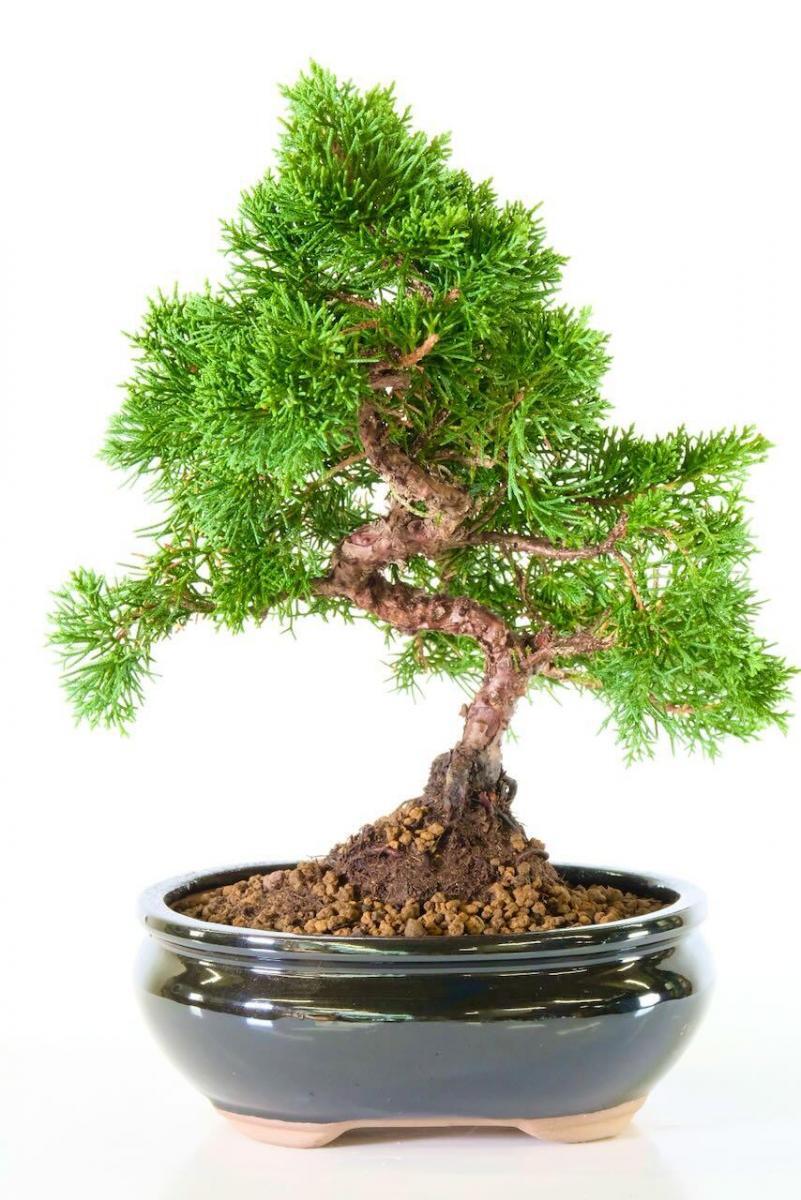
Gnarled Hardy Chinese Juniper Bonsai
Bonsai Are Not Genetically Modified
Let’s address the myth directly.
Bonsai are grown from normal trees. They are not genetically engineered. Neither are they laboratory dwarfs. Nor are they altered at the DNA level.
In fact, if you planted a bonsai in the ground and stopped pruning it, the tree would grow to full size.
The “dwarf” appearance comes from:
- Regular pruning of branches
- Root pruning
- Growing in a pot which reduces the speed of growth
These horticultural practices control vigour and proportion. They do not alter genetics.
Why Some Species Make Better Dwarf Bonsai Trees
Although any tree can technically become a bonsai, not all species work well — especially commercially in the UK.
We deliberately choose species that:
- Naturally produce smaller leaves
- Respond well to pruning
- Develop fine twigging (ramification)
- Grow reliably indoors or outdoors in the UK climate
- Maintain good proportions when miniaturised
For example, species like Chinese Elm (Ulmus parvifolia), Fukien Tea (Carmona microphylla), and Juniper (Juniperus chinensis) adapt beautifully to bonsai culture because their leaf size and growth habits already suit small-scale design.
However, large-leaved trees such as:
- Sweet Chestnut (Castanea sativa)
- Horse Chestnut (Aesculus hippocastanum)
- Sycamore (Acer pseudoplatanus)
- Weeping Willow (Salix babylonica)
- Wisteria (Wisteria sinensis)
present real challenges.
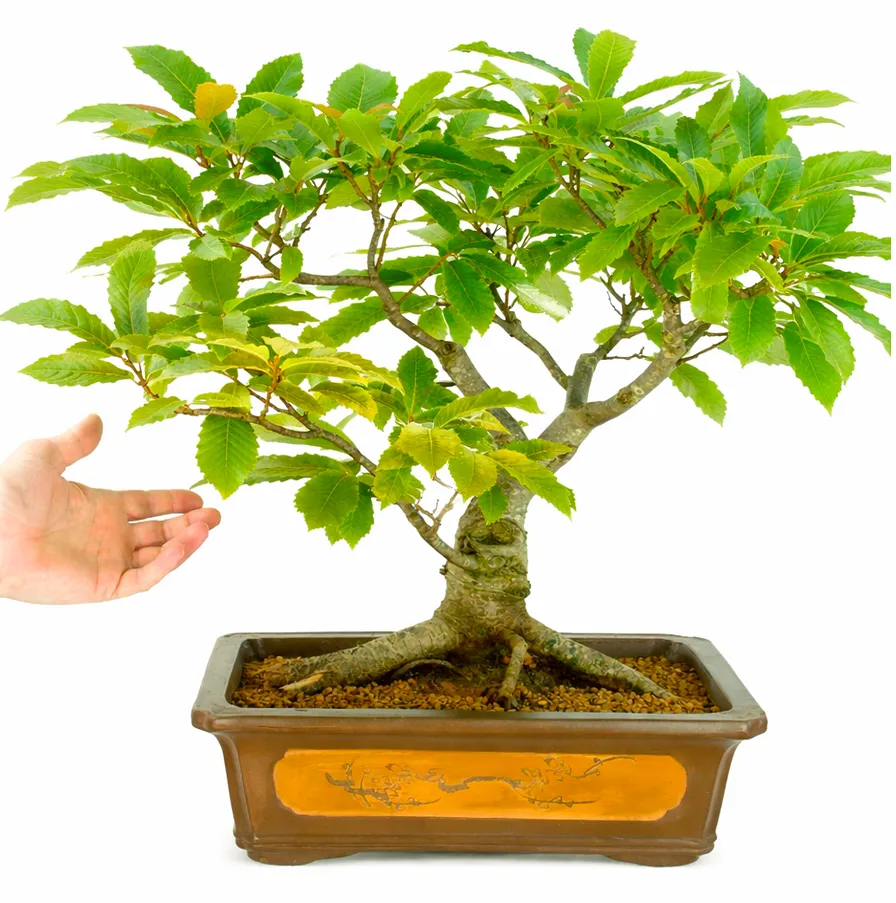
Why Chestnut, Willow and Wisteria Are Difficult as Dwarf Bonsai Trees
Large-leaved trees naturally want to grow vigorously. They produce:
- Oversized leaves
- Long internodes (large spacing between leaves)
- Strong apical dominance
- Fast, coarse growth
If you restrict them too aggressively, they simply weaken. Therefore, when growing species like sweet chestnut or horse chestnut, it makes far more sense to create a larger bonsai rather than forcing them into tiny proportions.
Trying to create a miniature horse chestnut often results in disproportionate leaves and poor structure.
In contrast, species with naturally smaller foliage maintain better visual balance when reduced.
Proportion matters more than size.
The Science of Leaf Reduction
Here is where things become fascinating.
When you prune a bonsai, the next flush of leaves often emerges smaller. Why?
Because pruning redistributes plant hormones — particularly auxins and cytokinins — which regulate growth. By interrupting strong apical growth, you encourage lateral bud activation.
As a result:
- Leaves reduce in size
- Internode length shortens
- Branching increases
Repeat this process through the growing season and something remarkable happens.
You improve ramification.
What Is Ramification?
Ramification refers to the fine, repeated branching of twigs.
Think of it like this:
A wild tree has thick branches that divide occasionally. A refined bonsai has branches that divide repeatedly into finer and finer twigs.
More ramification means:
- Greater visual density
- Improved proportion
- Smaller leaf appearance
- Increased realism
In fact, good ramification is one of the main characteristics that separates a beginner bonsai from a high-quality specimen.
Why Leaf Size Matters in a Dwarf Bonsai Tree
Leaf size directly affects scale.
If a bonsai has large leaves, it immediately looks like a small tree. However, if the leaves are tiny relative to the trunk, the tree appears ancient and full-sized — just in miniature.
This illusion is what makes bonsai so compelling.
Interestingly, while leaves reduce in size through pruning, fruits and flowers often do not.
Unusual Fact: Bonsai Flowers and Fruits Stay Full Size
Here is something most people do not expect.
On many bonsai:
- Flowers remain normal size
- Fruits often remain full size
- Sometimes fruits even appear larger relative to the tree
For example, a tiny crab apple bonsai can carry apples that look oversized in comparison to the miniature canopy.
Leaves reduce through repeated pruning cycles. Flowers and fruit, however, follow their genetic blueprint.
This contrast creates dramatic seasonal displays.
Why We Grow Bonsai at All
So why do we invest so much time shaping and pruning trees?
Because bonsai connect us to natural growth cycles in a concentrated form.
They allow us to:
- Observe seasonal change closely
- Practice patience and precision
- Shape living material responsibly
- Cultivate calm and focus
Unlike genetic engineering, bonsai require partnership with the plant.
You guide it. You do not override its biology.
The Commercial Reality of Bonsai Growing in the UK
From a nursery perspective, we must also consider climate and reliability.
In the UK, we choose species that:
- Thrive indoors in winter
- Tolerate fluctuating light levels
- Withstand outdoor UK conditions
- Respond consistently to pruning
Therefore, we focus on species that naturally lend themselves to proportion and structure.
Trying to commercially produce large-leaved dwarf bonsai trees like chestnut or willow at small sizes simply does not yield consistent, healthy results.
Instead, when growing those species, we recommend larger bonsai forms where leaf scale remains harmonious.
Final Thoughts: Dwarf Bonsai Trees Are a Craft, Not a Lab Product
As someone who spent years studying plant molecular biology, I can assure you:
Bonsai are not genetically engineered.
They are shaped by:
- Careful pruning
- Root management
- Seasonal technique
- Long-term patience
A dwarf bonsai tree reflects horticultural skill, not laboratory intervention.
And perhaps that makes them even more remarkable.


Paul christie –
I would like to thank you for this really interesting article about dwarf bonsais! Amazing! Every day is a school day! 🥰