

By Bonsai expert Lloyd Noall — nearly 40 years of bonsai-growing experience at Bonsai Direct.
🌤 Why Some Indoor Bonsai Struggle Without Enough Light
Two of the most common questions we hear are:
“Can I grow bonsai indoors if my home doesn’t get much natural daylight?”
“Can I use a grow light to grow indoor bonsai trees?”
Light is one of the most important factors for plant health. Bonsai trees, like all plants, depend on light to produce energy through photosynthesis. Without enough of it, the tree becomes weak, with pale leaves, long thin shoots, and poor vigour.
This is especially true in winter when UK daylight hours are short. Many people find that their tropical or subtropical bonsai — such as Fukien Tea, Chinese Elm, or Serissa (Tree of a Thousand Stars) — start dropping leaves or looking tired around this time.
If your bonsai sits away from a window, it’s very likely not getting enough light. That’s where grow lights can make all the difference. Of course, through the summer months, you could grow your indoor bonsai outside, which encourages much faster, healthier growth — but not everyone has the outdoor space or garden to do this.
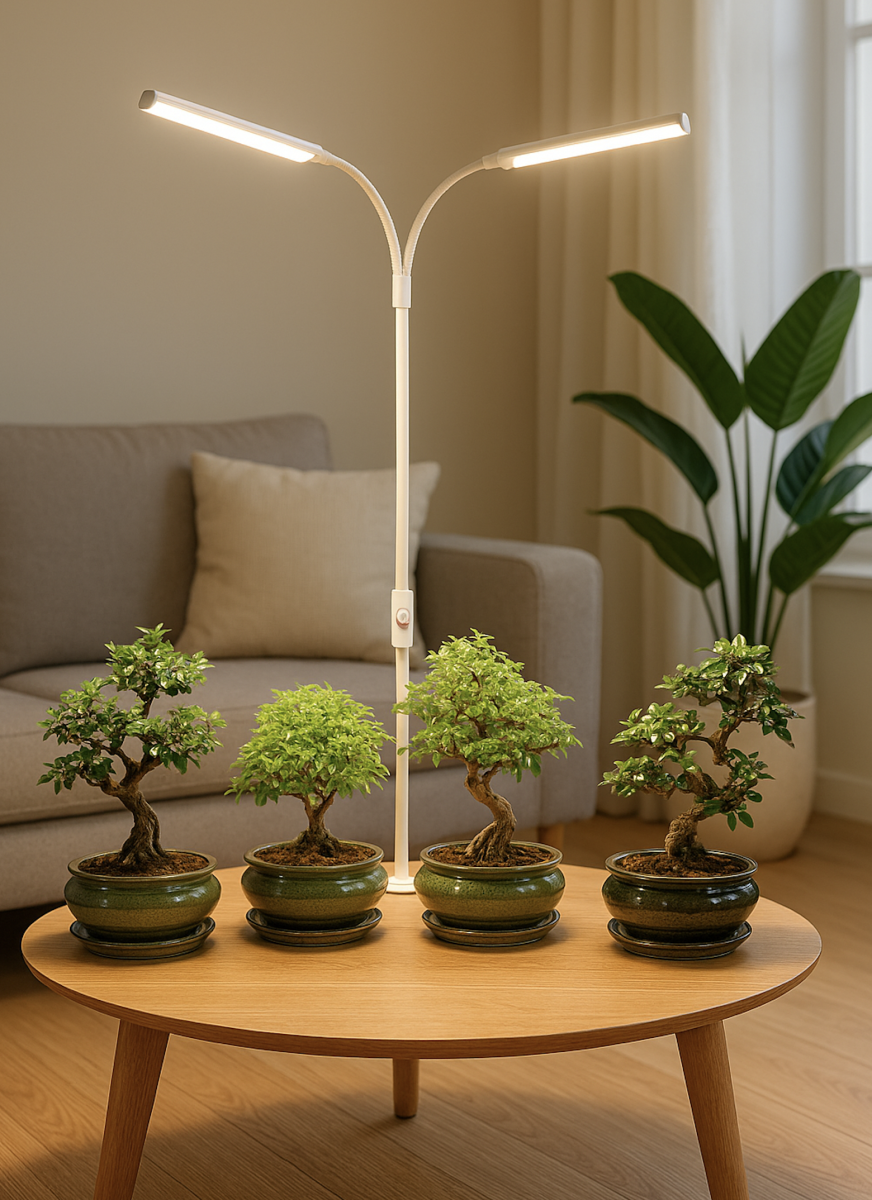
I purchased this plant grow light – Floor Grow Lights for Indoor Plants, 114 LEDs Full Specturm Plant Lighs for Indoor Growing with 4/8/12/16H Timer, 3 Colour Modes, 5 Brightness, Height Adjustable Standing Plant Lamp
💡 Why You Might Need a Grow Light
Tropical and subtropical bonsai species need around 12–15 hours of light per day to stay healthy year-round. In the UK, winter daylight averages only 7–8 hours — and often less in cloudy weather.
Grow lights can:
- Supplement low daylight in dark homes or offices
- Support healthy growth through winter
- Reduce leaf drop and pest risk caused by weak, stressed trees
- Help young or recovering bonsai strengthen faster
Without enough light, indoor bonsai may develop spindly growth, pale leaves, and become prone to spider mites or scale insects. A good-quality grow light mimics the spectrum of natural sunlight — giving your bonsai the conditions it needs to thrive, even in a gloomy room.
🌿 Our Real-Life Indoor Bonsai Tree Grow Light Experiment
To test how well a grow light could support bonsai, we deliberately chose a dark and cool room — one that most people would consider unsuitable for growing plants. We used a Floor Grow Light for Indoor Plants with 114 full-spectrum LEDs (including warm white, cool white, blue, and red light) and an automatic timer set for 12 hours of light per day.
We tested four different bonsai:
- Chinese Elm (Ulmus parvifolia)
- Serissa foetida (Tree of a Thousand Stars)
- Fukien Tea (Carmona microphylla)
- Roseapple (Syzygium buxifolium)
Each bonsai was chosen specifically because it wasn’t in perfect condition — a true test of whether the grow light could help weaker trees recover.
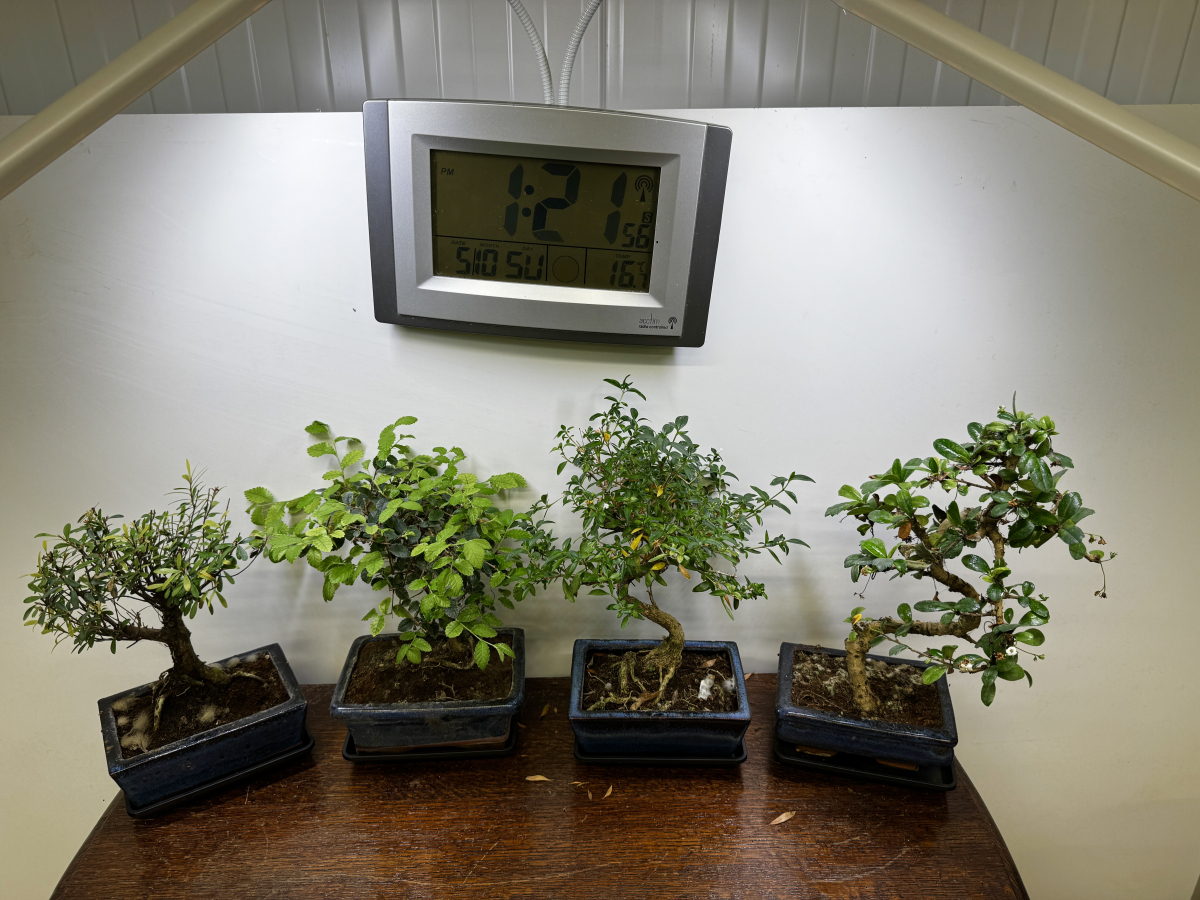
After one month, the results were impressive:
🌳 Chinese Elm: Excellent growth and colour; strong new shoots formed.
🌸 Serissa: Unexpectedly vigorous, with fresh new leaves despite cooler temperatures.
🌿 Fukien Tea: Healthier and glossier foliage, with visible new growth.
🍃 Syzygium: The slowest grower of the group (as expected for the season), but steady improvement.
Even in these poor conditions, all trees responded much better than expected.
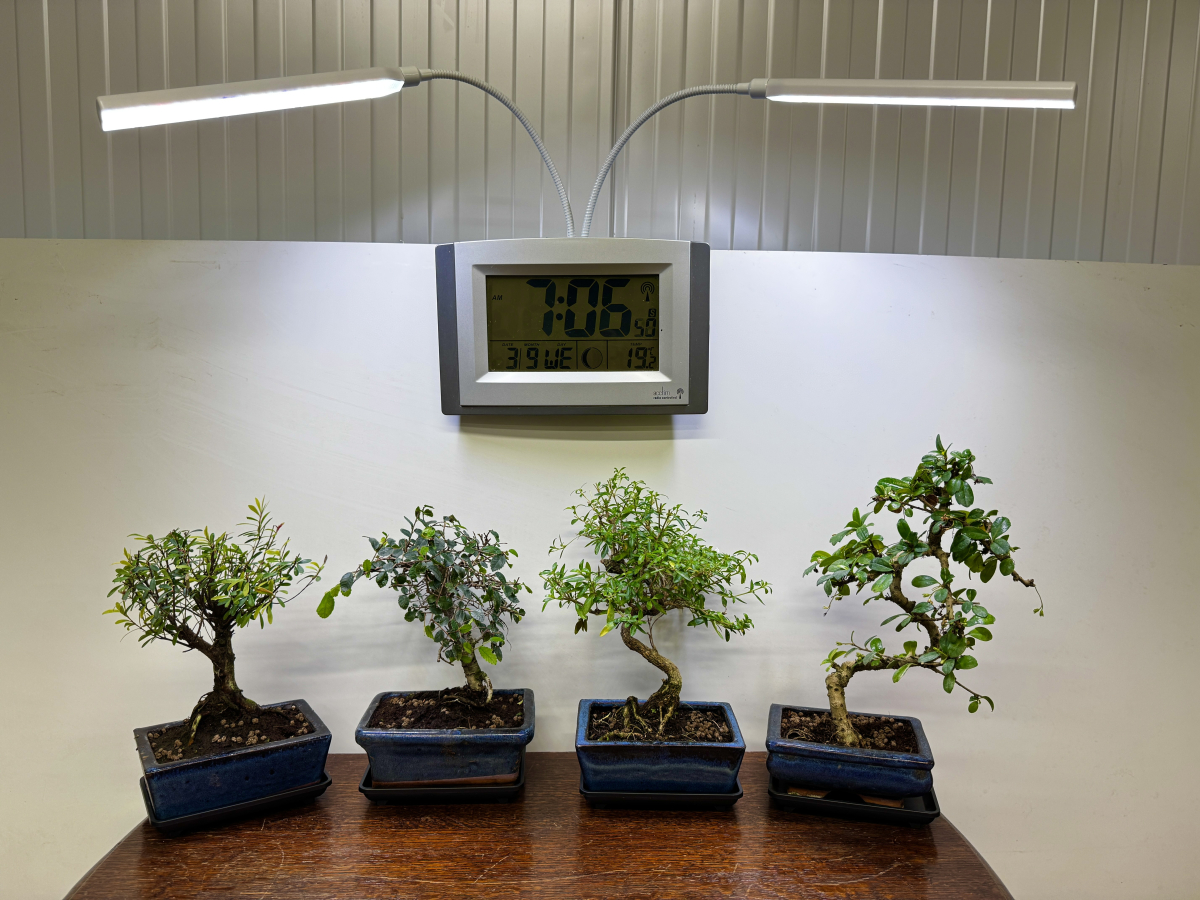
From left to right – Roseapple Myrtle (Syzygium buxifolium) – Chinese Elm (Ulmus parvifolia) – Tree a Thousand Stars (Serissa foetida) – Fukien tea tree (Carmona microphylla)
I chose weaker specimens as I wanted this to be a really good test.
The location was very dark and a little cool.
⚙️ The Grow Light We Used
The double-head design and 360° flexible goosenecks provided great coverage. Adjustable poles (60–174cm) made it easy to set the light just above the canopy.
Here’s what made it effective:
- Full-spectrum light (3000K warm white, 6000K cool white, 460nm blue, 660nm red) – closest to natural sunlight
- Automatic timer – set for 12 hours on / 12 hours off
- Low heat output – safe for bonsai leaves
- Stylish design – actually looks good in the home!
At just over £30 including delivery, it’s a brilliant low-cost solution for anyone with darker rooms.
🌞 How Much Light Do Bonsai Trees Need?
| Bonsai Type | Recommended Light Intensity (lux) | Daily Light Duration |
|---|---|---|
| Temperate (e.g. Maple, Pine) | 700+ | 9 hours |
| Subtropical (e.g. Chinese Elm) | 1,000–2,500 | 12–15 hours |
| Tropical (e.g. Fukien Tea, Serissa) | 1,500–5,000 | 12–15 hours |
(For comparison: bright outdoor summer light can reach 100,000 lux!)
For most indoor bonsai, 12 hours of full-spectrum LED light daily provides an ideal substitute during darker months.
💡 Placement Tips
- Position the grow light 30–40cm above the tree for optimal results.
- Avoid lighting the tree 24 hours a day — bonsai need darkness too.
- Run the light for 12–15 hours daily from September to March, or whenever daylight drops below 12 hours.
- A plug-in timer makes this simple to automate.
- Pair with moderate humidity to prevent dry air stress from central heating.
🔌 Choosing the Right Type of Grow Light for Growing Indoor Bonsai Trees
Not all lights are equal! Here’s a quick comparison:
| Type | Pros | Cons |
|---|---|---|
| LED (Full Spectrum) | Energy efficient, long lifespan, cool operation, ideal light spectrum | Slightly higher upfront cost |
| Fluorescent Tubes | Good for close-range use, low heat | Shorter lifespan, higher energy use |
| Sodium Vapour Lamps | Very bright | Too hot, expensive, not ideal for small spaces |
| Energy-Saving Full Spectrum Bulbs | Compact and simple | Less efficient than LEDs |
| Incandescent Lamps | ❌ Not suitable – too hot and wrong spectrum | — |
We recommend LED full-spectrum grow lights — they give the best balance of light quality, safety, and running cost.
🌺 The Results — and Our Verdict
After a month of testing, we were genuinely impressed. Every bonsai improved in health, vigour, and colour — especially the Serissa and Fukien Tea, which are normally fussy about light and temperature. The Chinese Elm (second from left) had amazing results. We did expect this and it is why the Chinese Elm always gets our top vote as one of the best indoor bonsai trees for beginners.
The trial proved that with a good-quality full-spectrum grow light, you can successfully grow indoor bonsai even in dark UK rooms.
Grow lights are no longer just for enthusiasts — they’re a simple, affordable way to ensure your bonsai stays strong and beautiful all year round.
🌱 Final Thoughts about Growing Indoor Bonsai Trees under Grow Lights
If you struggle with low daylight or want your bonsai to look its best through winter, a full-spectrum LED grow light is well worth trying.
It’s inexpensive, easy to use, and can make a remarkable difference to your bonsai’s health, colour, and growth.
So yes — you can grow indoor bonsai successfully under grow lights. And as our experiment proved, even in a dark, cool corner, a little extra light goes a long way.
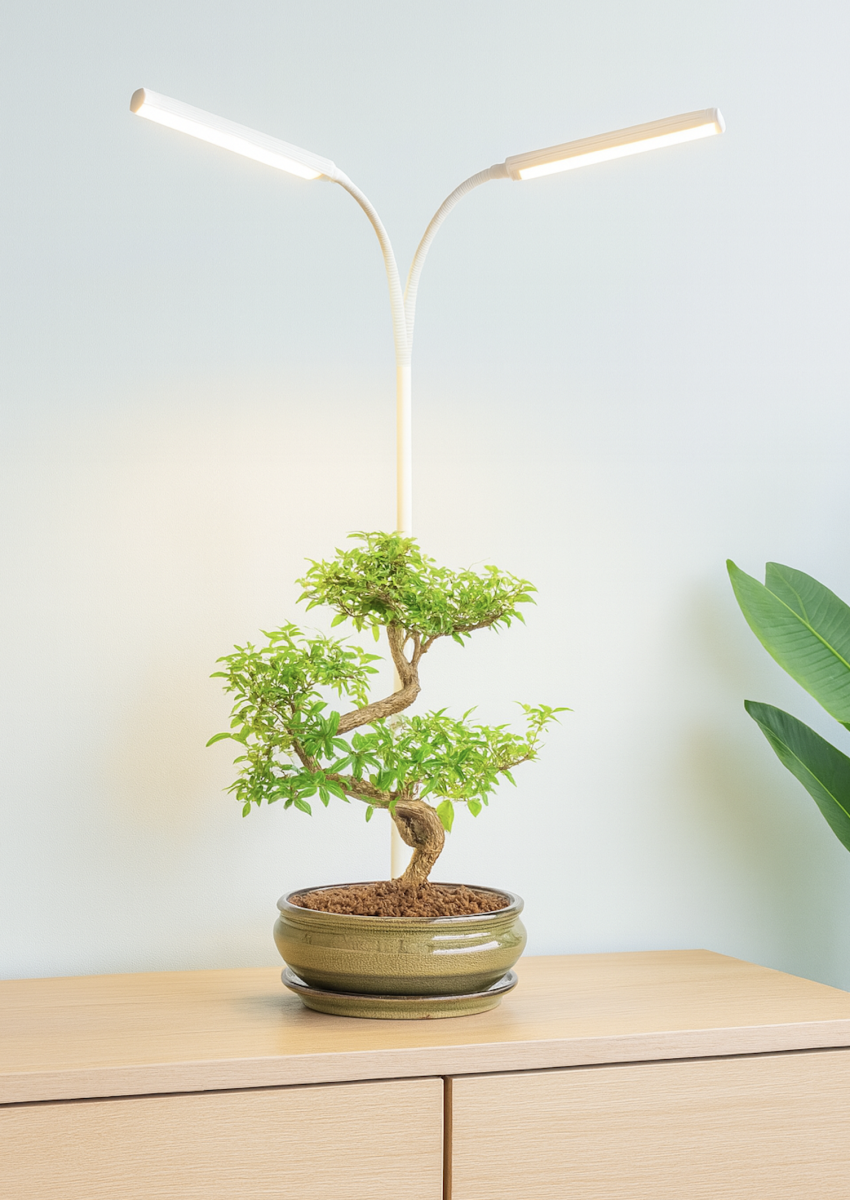
🚚 Bonus Tip: Growing with Bonsai Direct
All bonsai from Bonsai Direct come with a printed care guide and expert advice.
If you’d like to try your own lighting experiment, browse our selection of indoor bonsai trees — ideal for homes, offices, and winter growing conditions.


phil s –
hmm, haven’t tried them myself, but saw some reviews on it. Seems like they have a decent variety of options. Might be worth a try on my bonsai.