

When you are choosing a bonsai tree, what makes one tree stand out from hundreds – or even thousands – of others?
It is a question we think about constantly at Bonsai Direct.
We are incredibly proud of our Premium Indoor Bonsai Collection. However, these trees don’t simply become “Premium” because they are older, larger or more expensive. Each one is selected from the thousands of bonsai we grow and care for at our Devon nursery.
Some catch our attention because of an extraordinary trunk. Others have beautiful exposed roots, exceptional taper or wonderfully balanced branches. Occasionally, a tree simply has something about it that is difficult to define – an artistic quality that makes you stop and look twice.
Once selected, the work doesn’t stop. Premium trees receive additional pruning and styling. We work on their branch structure, ramification, roots and overall balance. Finally, we select a quality ceramic bonsai pot to complement the individual tree.
Only then is each bonsai individually photographed, measured and described for our website.
So, what exactly are we looking for?
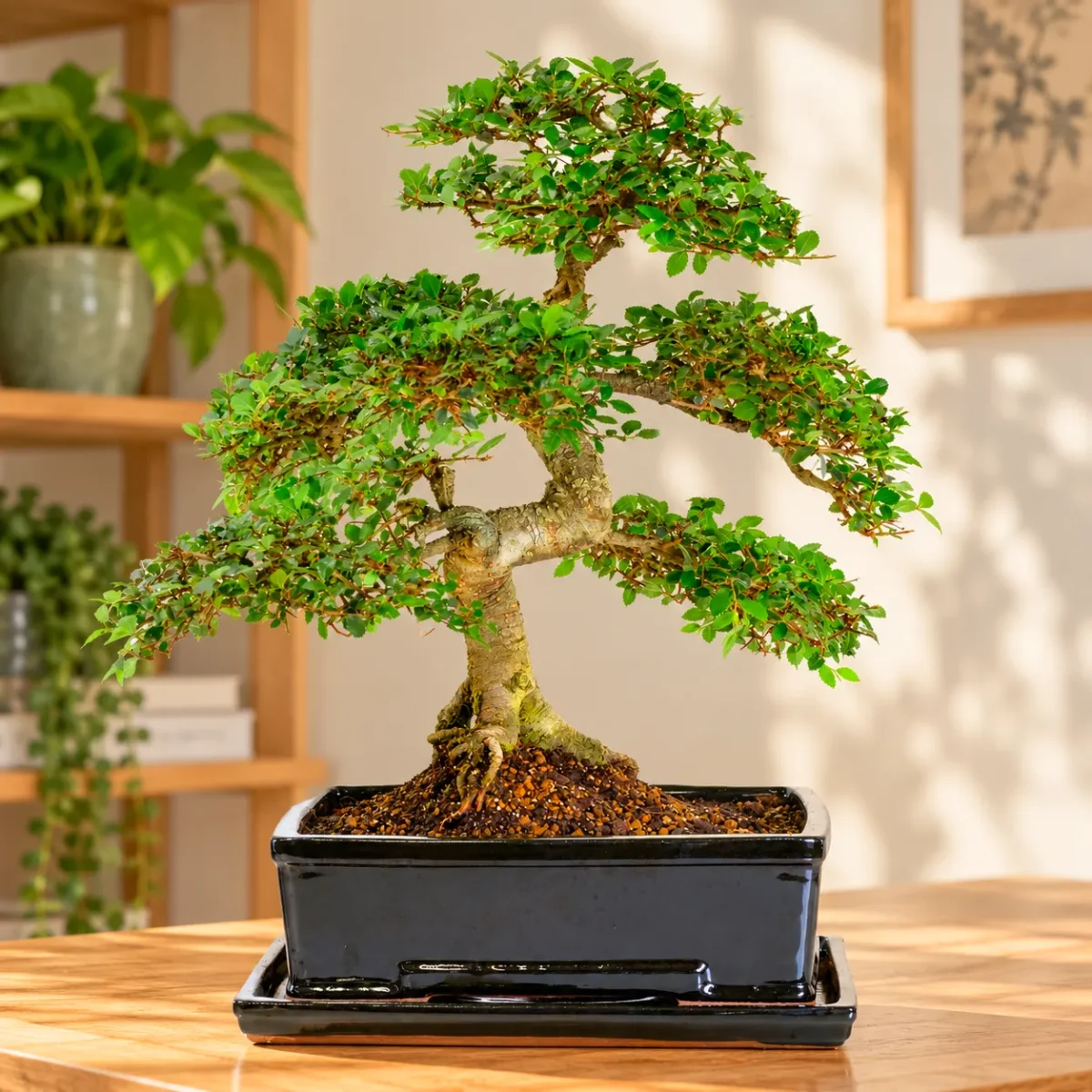
This is a premium quality Chinese Elm bonsai grown by Lloyd Noall from Bonsai Direct. A beautiful easy care bonsai perfectly suited to beginners.
It Usually Starts with the Trunk
When we look through large groups of bonsai for potential Premium Collection trees, the trunk is one of the first things that catches our attention.
Foliage can grow back. Branches can be pruned and developed. However, the fundamental character of a mature trunk takes years to create.
We look for movement, taper, proportion and individuality.
A trunk doesn’t necessarily need dramatic twists and turns to be beautiful. Sometimes a relatively straight trunk has wonderful elegance. Another tree may have pronounced curves, natural scars, textured bark or an unusual feature that gives it tremendous character.
What matters is whether the trunk works as part of the whole composition.
We particularly like trees that encourage your eye to travel naturally from the base towards the top. This movement gives a bonsai rhythm and helps it look like a mature tree rather than simply a young plant growing in a shallow pot.
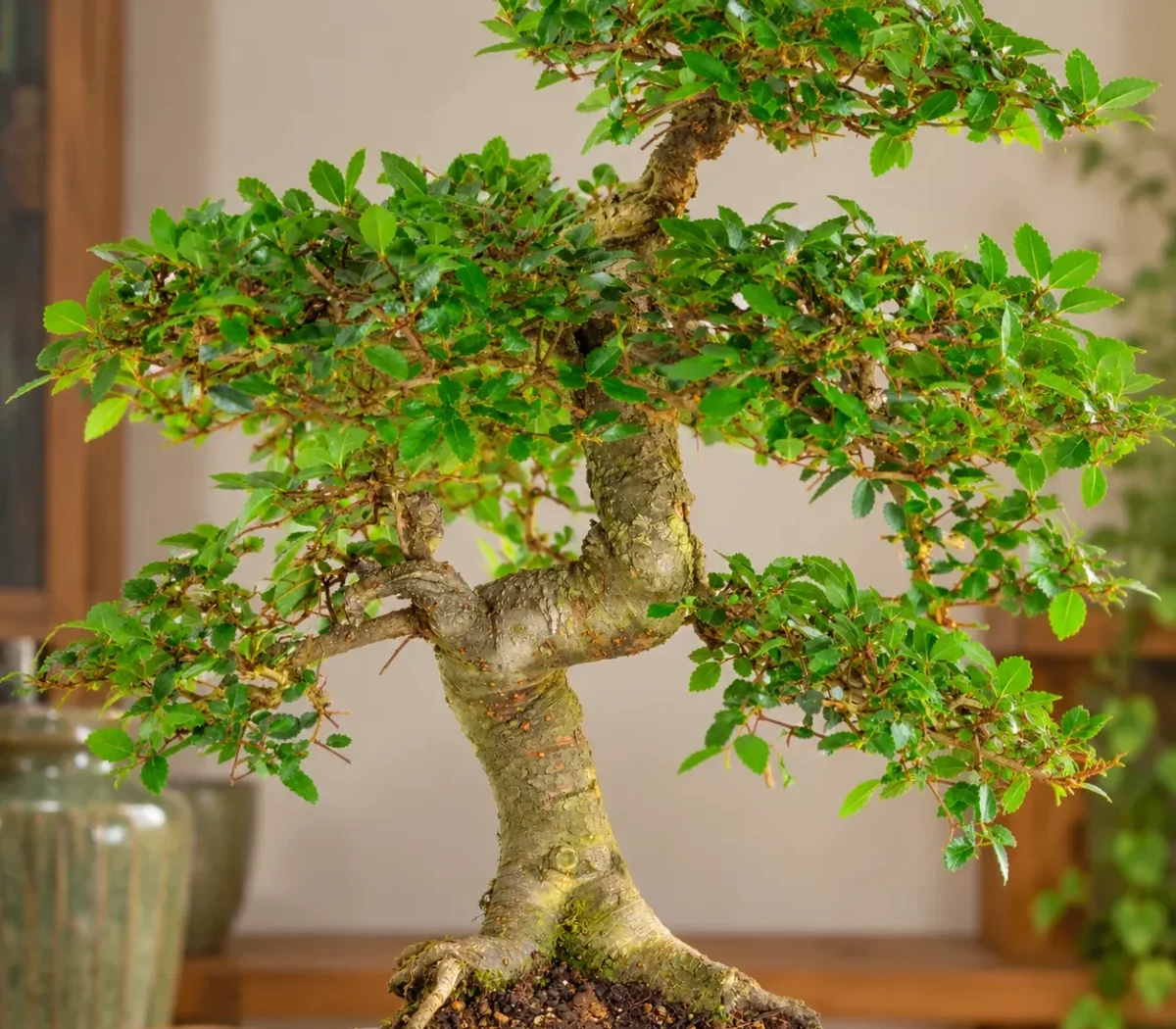
This close up of the trunk allows you to appreciate the movement, artistry and taper.
Taper Creates the Impression of Age
Taper is another characteristic we look for carefully.
In simple terms, good taper means that the trunk is broader and more powerful towards the base before gradually becoming finer as it rises.
Look at an old tree growing naturally and you will often see this characteristic. The trunk has strength where it meets the ground, while the upper structure becomes progressively more delicate.
The same principle is extremely effective in bonsai.
Good taper can make a relatively small bonsai look remarkably mature. Conversely, a trunk that remains exactly the same thickness from bottom to top can sometimes lack the convincing proportions we are looking for.
Of course, bonsai aren’t manufactured objects and nature doesn’t follow a template. We aren’t searching for identical trees with mathematically perfect taper.
We are looking for character.
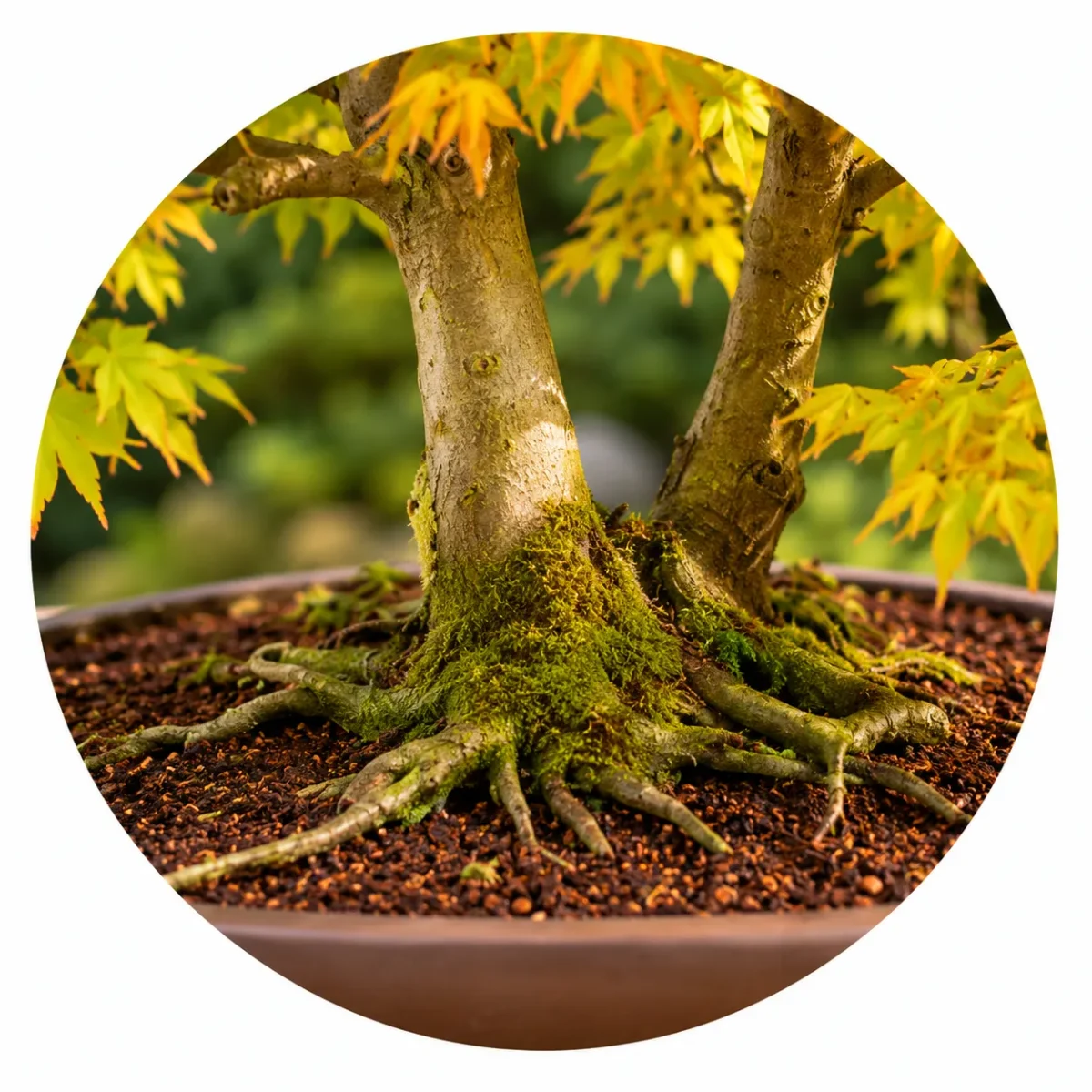
The nebari or exposed root flare of this bonsai really adds to its artistic appeal and reflects the natural beauty of woodland trees.
Nebari – The Importance of the Roots You Can See
One of our favourite features is good nebari.
Nebari is the Japanese term used to describe the visible surface roots and root flare where the trunk meets the soil.
It can make an enormous difference to the appearance of a bonsai.
A strong root flare visually anchors the tree into the pot. Instead of looking as though a trunk has simply been inserted into the compost, good nebari gives the impression that the tree has been growing in that position for many years.
It can also add tremendous character.
Some bonsai develop a broad, powerful root base. Others have individual exposed roots that twist and flow into the soil. Occasionally, we select trees with more pronounced exposed-root or neagari characteristics, where sections of root are deliberately visible above the soil.
When we identify a potential Premium tree, we may work further on the root area so that its best features can be appreciated.
Ramification – Why More Branches Aren’t Simply More Branches
Ramification is one of those bonsai terms that sounds complicated but describes something quite straightforward.
It means increasingly fine branch division.
A young tree might have a trunk with several primary branches. Those branches then divide into secondary branches. With repeated pruning and development, they divide again into increasingly fine growth.
This creates ramification.
Good ramification helps produce the dense, refined canopy associated with a mature bonsai. More importantly, it helps maintain the illusion of scale.
Imagine a miniature tree with only three thick branches supporting all its foliage. It may be healthy, but it won’t necessarily look like a mature tree.
Now imagine those same branches dividing repeatedly into an intricate network of finer twigs. Suddenly, the whole composition becomes much more convincing.
Our Premium Indoor Bonsai receive additional pruning and styling to encourage this finer structure.
It takes time, but the difference is worth it.
Branch Placement Matters
More branches don’t automatically make a better bonsai.
Where those branches grow matters just as much.
When selecting and styling our Premium trees, we consider how individual branches contribute to the overall composition. A well-positioned branch can create depth, balance an opposing branch or fill an otherwise empty section of canopy.
Sometimes the best thing we can do is remove a perfectly healthy branch.
That can initially seem counterintuitive. After all, why cut off healthy growth?
Because bonsai styling is as much about what you remove as what you keep.
Removing an unnecessary branch can reveal a beautiful section of trunk, improve the silhouette or allow light into the interior of the canopy. It can also direct the tree’s energy towards the branches we want to develop.
This selective pruning is one of the ways a good bonsai gradually becomes a more refined one.

Allowing spacing between the branches and regular pruning gives a neater uncluttered appearance with improved ramification.
We Look for Balance – Not Perfect Symmetry
Balance is extremely important in bonsai, but balance doesn’t mean symmetry.
In fact, perfect symmetry can sometimes make a tree look less natural.
A trunk may move strongly towards one side while a branch visually balances it from the other. A canopy may be deliberately uneven. One side might contain more foliage while carefully positioned negative space prevents the composition from feeling heavy.
This asymmetry often creates movement and interest.
When we assess a potential Premium tree, we look at the whole composition. The roots, trunk, branches, foliage and eventually the pot all need to feel as though they belong together.
Sometimes this balance is immediately obvious.
At other times, we can see the potential but know that further pruning and styling will reveal it.
Negative Space Is Part of the Tree Too
One of the less obvious things we consider is the empty space between branches.
In bonsai, what you can see through the tree can be almost as important as the foliage itself.
If every gap is filled with leaves, an interesting trunk can disappear behind a solid mass of green. The tree can also lose much of its visual depth.
Careful pruning creates areas of negative space. These little windows allow you to see through the canopy and appreciate the trunk and branch structure underneath.
They also help define individual foliage pads and give the composition a lighter, more mature appearance.
This is another reason our Premium trees undergo additional pruning before they are photographed.
Age Matters – But Age Isn’t Everything
Our Premium Indoor Bonsai Collection is enormously varied.
Trees typically range from approximately seven years old to exceptional specimens approaching 50 years of age. Naturally, age contributes to the development of bark, trunk thickness, roots and branch structure.
However, age alone doesn’t determine the quality of a bonsai.
Two 15-year-old trees of the same species can look remarkably different.
Growing conditions, pruning history, trunk development, root structure and countless other factors influence how each tree develops. Just like trees in nature, no two bonsai follow exactly the same path.
A younger tree with fantastic trunk movement and beautiful proportions can sometimes catch our eye more than an older tree.
We therefore look at the individual bonsai rather than selecting purely according to age.
Proportion Becomes Increasingly Important
A good bonsai needs to work visually as a complete miniature tree.
That means we consider the relationship between the trunk, foliage, branches, roots and eventual pot.
A particularly thick trunk may suit a broader canopy. A delicate tree might look far better with fine branching and a lighter silhouette.
Leaf size matters too.
Species with naturally tiny foliage can produce particularly convincing miniature proportions. However, careful pruning can also help refine the foliage and structure of many other species.
This is especially important with smaller bonsai. The smaller the tree becomes, the more noticeable a disproportionately heavy branch or oversized section of foliage can be.
Health Always Comes Before Appearance
A beautiful trunk isn’t enough.
Before a tree joins our Premium Collection, health and vigour are fundamental considerations.
We want strong root systems, healthy foliage and active growth appropriate to the species and season. We also inspect the tree carefully as part of its ongoing nursery care.
There would be little point creating an exquisitely styled bonsai if the horticulture behind it wasn’t right.
Good bonsai starts with a healthy tree.
Everything else – pruning, styling, ramification and presentation – is built upon that foundation.
The Right Pot Can Transform a Bonsai
Once we are happy with the tree itself, choosing the pot becomes another important decision.
A bonsai pot shouldn’t simply be a container.
Its proportions, shape, depth, glaze and colour all influence how we see the tree above it.
A powerful tree with a substantial trunk might suit a strong rectangular pot. Meanwhile, an elegant tree with gentle movement can look beautiful in a softer oval form.
Colour can make an equally dramatic difference.
Deep blues can contrast beautifully with fresh green foliage. Neutral creams allow an interesting trunk to take centre stage. Rich earthy glazes can complement aged bark, while more contemporary colours can completely change the character of an indoor tree.
For our Premium Collection, we use a better range of quality ceramic bonsai pots. Wherever appropriate, we also pair them with matching ceramic drip trays.
We don’t want the pot to compete with the bonsai.
We want the two to look as though they were meant to be together.
What Is Under the Soil Matters Too
Something you won’t see in our photographs is equally important: the growing medium.
Bonsai live in relatively shallow containers, so good drainage is essential.
We use quality bonsai potting media selected to provide the balance of moisture retention, aeration and drainage required for healthy root growth.
This becomes particularly important indoors. Bonsai roots need moisture, but they also need oxygen. A poor growing medium that remains saturated for prolonged periods can create an unhealthy root environment.
The pot may provide the finishing touch visually, but what goes inside it matters enormously to the long-term health of the tree.
Different Species Offer Different Qualities
We don’t expect every species to display the same characteristics.
A Chinese Elm might catch our attention because of beautiful bark, tiny foliage, taper and intricate ramification.
A mature Ficus may have extraordinary aerial roots and a powerful trunk.
A Fukien Tea Tree can combine tiny glossy leaves with delicate white flowers and beautifully fine branching.
A Sweet Plum might offer wonderful trunk movement alongside constantly changing foliage colours.
Understanding the natural characteristics of each species is important when deciding what makes an individual tree special.
We aren’t trying to make every bonsai conform to one ideal.
Instead, we want to bring out the best qualities of that particular tree.
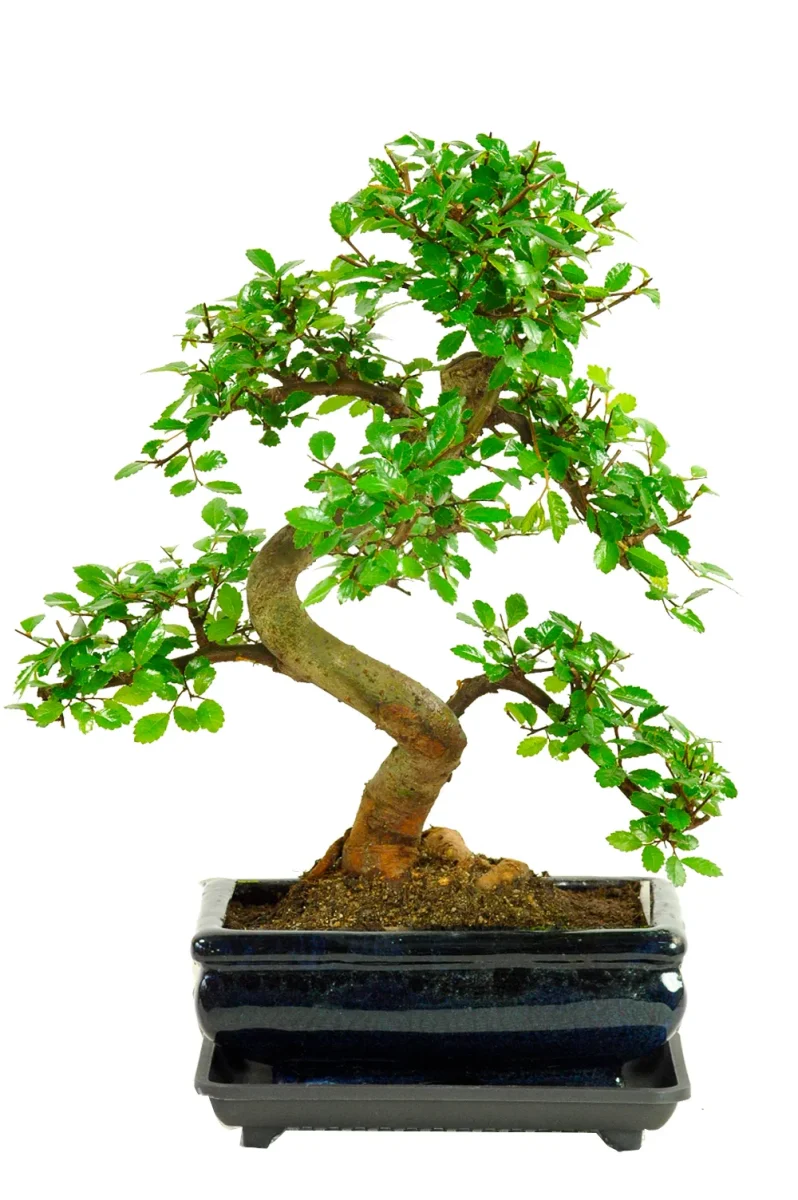


Then Comes More Pruning and Styling
Being selected for our Premium Collection isn’t the end of the process.
In many ways, it is another beginning.
Once we identify a promising tree, our nursery team can spend considerably more time refining it. We may remove unwanted growth, improve the silhouette, open areas within the canopy and encourage better ramification.
We can also work on the visible root structure and consider how best to position the tree within its new pot.
Sometimes relatively small changes reveal something that was previously hidden.
Removing one branch might expose a beautiful curve in the trunk. Changing the planting angle slightly can make the tree appear more dynamic. Opening a dense section of foliage may suddenly reveal the branch structure beneath.
This is one of the most enjoyable parts of working with bonsai.
You are not creating the tree from nothing. Instead, you are discovering the best version of what is already there.
Finally, We Photograph the Exact Tree
There is one final part of our Premium Collection that is particularly important to us.
We photograph every bonsai individually.
Bonsai are living trees. Even when two trees are the same species, age and approximate size, they can be completely different.
One customer may love a dramatic twisting trunk. Another might prefer an elegant upright tree. Someone else may fall in love with exposed roots, an unusual branch or simply the overall shape of a particular bonsai.
For that reason, we want you to be able to choose.
Our Premium Bonsai listings show the individual tree for sale. We also provide its approximate age and measurements, together with a detailed description of the features that make that particular bonsai interesting.
The bonsai you choose is therefore the bonsai that arrives at your door.
What Makes a Bonsai ‘Premium’ to Us?
Ultimately, there isn’t one feature that automatically makes a bonsai worthy of our Premium Collection.
It is a combination.
We look for excellent trunks, attractive taper, interesting roots and good nebari. We consider branch placement, ramification, proportion, balance and overall artistic appeal.
However, we also look for individuality.
Some of our favourite trees aren’t necessarily the biggest or oldest. They are the ones with personality – perhaps an unusual twist at the base, a beautifully weathered section of bark or a trunk that has developed in a completely unexpected direction.
Those imperfections and differences are part of what makes bonsai so fascinating.
From thousands of trees growing at our nursery, these are the bonsai that make us stop for another look.
We then spend more time pruning, styling and presenting them before photographing each one individually.
And perhaps that is the simplest explanation of our Premium Collection: they are the trees we would be tempted to take home ourselves.



0 replies