

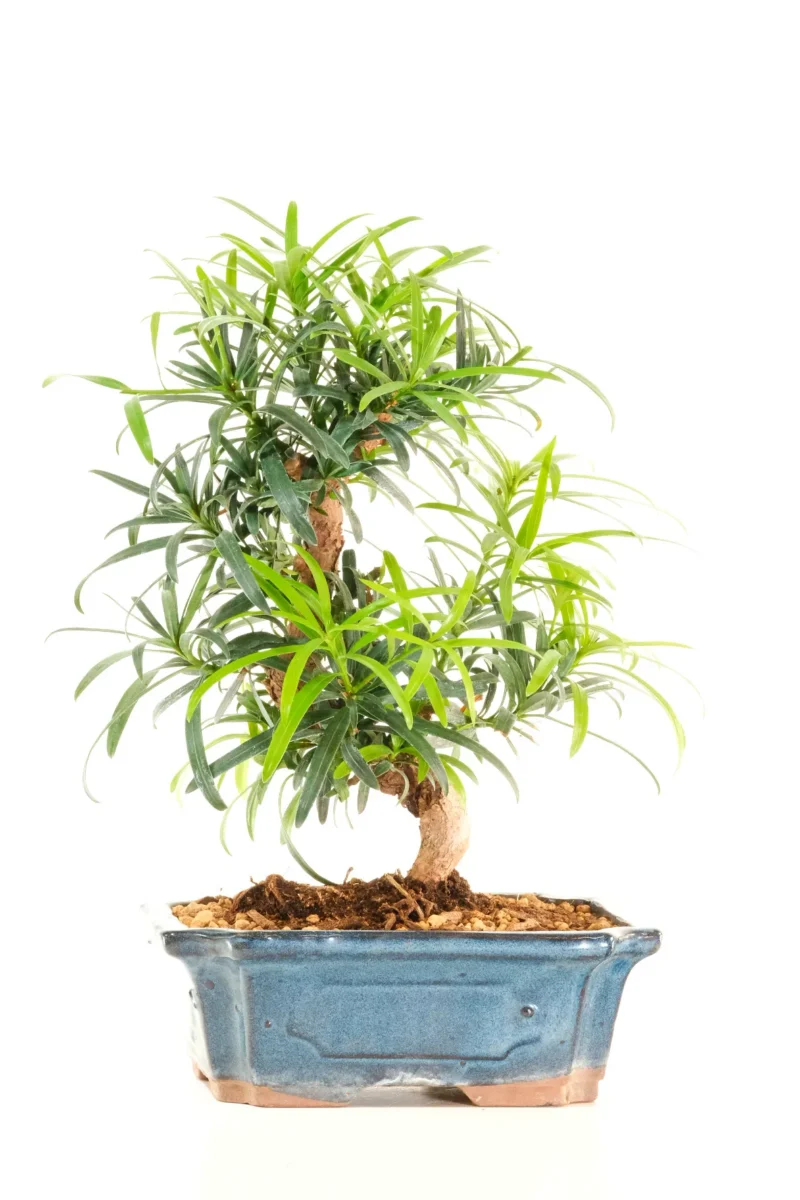
The Podocarpus Buddhist Pine (Podocarpus macrophyllus) is one of the world’s most elegant evergreen bonsai species. Admired for its powerful trunks, beautifully textured bark and graceful evergreen foliage, it has been cultivated in China and Japan for centuries. Known throughout East Asia as Luo Han Song (罗汉松), or the Buddhist Pine, it is deeply respected for both its beauty and its symbolism.
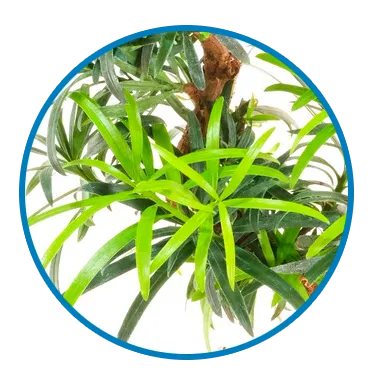
Unlike many bonsai, the Podocarpus remains attractive throughout every season. Its long, leathery leaves stay deep green all year, while fresh new shoots emerge in vibrant lime green before gradually maturing into rich emerald tones. As the tree ages, the trunk thickens, the bark develops increasing texture and the branch structure becomes ever more refined.
With patience and careful pruning, this species rewards its owner with exceptional character and longevity.
Why Bonsai Enthusiasts Love Podocarpus
The Buddhist Pine has become one of the most respected evergreen bonsai species because it offers a unique combination of beauty, resilience and history.
Its main attributes include:
- Elegant evergreen foliage throughout the year.
- Strong trunks with excellent taper and movement.
- Attractive textured bark that improves with age.
- Dense foliage pads and excellent branch ramification.
- Outstanding response to pruning and styling.
- Slow, graceful development.
- Incredible longevity.
- Rich symbolism rooted in Buddhist tradition.
Few bonsai species combine refinement and cultural significance quite so successfully.
A Living Fossil
Although commonly called the Buddhist Pine, Podocarpus macrophyllus is not actually a pine.
Instead, it belongs to the ancient Podocarpaceae family, one of the oldest surviving groups of conifers on Earth.
Scientists believe ancestors of today’s Podocarpus trees shared the landscape with dinosaurs more than 200 million years ago. This extraordinary heritage gives the species a timeless quality that few other bonsai can match.
Unlike true pines, Podocarpus produces elegant strap-shaped leaves instead of clusters of needles. Their soft, leathery texture creates a calmer, more refined appearance that suits both traditional and contemporary bonsai styling.
A Bonsai That Improves Every Year
Many bonsai reach their peak relatively early.
Podocarpus does exactly the opposite.
Each year the trunk gains strength, the bark develops more texture and the branch structure becomes increasingly refined. Careful pruning encourages dense foliage pads while allowing the tree to retain its naturally graceful appearance.
Because the species grows steadily rather than rapidly, every stage of its development feels rewarding. The years simply make it better.
Should You Grow a Podocarpus Buddhist Pine Bonsai Indoors or Outdoors?
This is probably the biggest misconception surrounding the Buddhist Pine.
Many websites describe Podocarpus as a permanent indoor bonsai.
Technically, they are correct.
The species can survive indoors.
However, our experience at Bonsai Direct suggests something rather different.
We have consistently found that Podocarpus grows more vigorously when treated as an outdoor bonsai during the warmer months. Fresh air, natural rainfall and increased light encourage stronger shoots, healthier foliage and a more vigorous root system.
From late spring until early autumn, place your bonsai outside in a bright, sheltered position.
As temperatures begin to fall, move it into a cool, bright, frost-free location such as an unheated conservatory, greenhouse, porch or cool room.
Although Podocarpus enjoys cool conditions, it does not tolerate frost.
Following this simple seasonal routine produces healthier, stronger bonsai that more closely follow their natural growing cycle.
Why Is It Called the Buddhist Pine?
Few bonsai species possess such deep cultural significance.
Throughout China and Japan, Podocarpus macrophyllus is known as Luo Han Song (罗汉松), meaning the Buddhist Pine or Arhat Pine.
Many people believe the elegant outline of mature trees resembles an enlightened Buddhist monk standing peacefully in flowing robes. Consequently, temples have planted Podocarpus for centuries as symbols of contemplation, wisdom and spiritual harmony.
Within Buddhist tradition it represents:
- Wisdom
- Enlightenment
- Spiritual awakening
- Inner peace
- Flexibility of mind
- Patience
- Endurance
Its symbolism extends beyond Buddhism.
In Feng Shui, the Podocarpus represents longevity, prosperity, noble character and protection. Many believe it attracts positive energy while encouraging resilience and lasting success.
Owning one is about far more than displaying a beautiful bonsai. It is about becoming part of a tradition that stretches back hundreds of years.
Flowers and Fruit
Although people usually grow Podocarpus for its elegant foliage and structure, mature trees can also flower and fruit.
During spring, tiny flowers appear almost unnoticed. Male trees produce slender yellow pollen cones, while female trees develop small green flowers.
If pollination occurs, female specimens may later produce unusual berry-like fruits. A bright crimson fleshy stalk supports a deep purple seed, creating one of the most distinctive fruits found on any bonsai species.
Not every tree will fruit. However, when it does, it adds another fascinating dimension to this remarkable species.
Caring for Your Podocarpus Bonsai
Despite its elegant appearance, Podocarpus is surprisingly forgiving.
Position
- Grow outdoors from spring until autumn.
- Move indoors to a cool, frost-free location during winter.
Water
- Water thoroughly whenever the compost begins to dry.
- Never allow the soil to remain permanently waterlogged.
Feed
- Apply bonsai fertiliser every week during the growing season.
- Reduce feeding during winter.
Prune
- Trim new shoots regularly.
- Frequent light pruning creates compact foliage pads and finer branching.
Repot
- Repot every two or three years during spring.
- Use a free-draining bonsai compost.
Interesting Facts
- The Podocarpus family predates many flowering plants by millions of years.
- It is not a true pine despite its common name.
- Some ancient specimens in Asia are several hundred years old.
- It responds exceptionally well to pruning and cloud-style shaping.
- Given proper care, it can live for centuries.
Final Thoughts
Elegant, evergreen and steeped in centuries of history, the Podocarpus Buddhist Pine is unlike any other bonsai species.
Treat it as an outdoor bonsai throughout the warmer months. Protect it from frost during winter. In return, it will reward you with healthy growth, rich evergreen colour and increasing character every year.
Whether you admire it for its remarkable history, its graceful architecture or its deep symbolism, the Buddhist Pine deserves its reputation as one of the world’s finest evergreen bonsai.



0 replies