

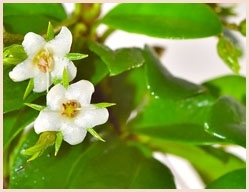
Firstly, the Fukien Tea Tree (Carmona microphylla) is a highly popular species of indoor bonsai. Widely recognised for its creamy textured bark and glossy green leaves, this bonsai is loved by beginners and enthusiasts alike.
During summer time these bonsai grow delicate white flowers which are beautifully enhanced by the rich leaves.
Additionally, this bonsai is easy to care for! They like their soil to be kept just damp at all times and we advise misting their leaves to increase humidity. Feed once a week and prune regularly to keep a neat shape and encourage growth. Also, these bonsai do not like the cold. As they are native to parts of Asia, they are used to warmer climates which is why they are grown indoors in the UK. Keep this bonsai in a warmer room with good daylight, but not in direct sunlight.
Fukien Tea Tree bonsai symbolism
The Fukien Tea Tree bonsai symbolises courage & heart, love & devotion. Many people like to gift a bonsai based on its symbolism, bringing this energy into their recipients home.
Lloyd has created a video to give you more information about this pretty bonsai species including some care advice. You can watch it here;
Transcription of Video about The Basic Care of the Fukein Tea Tree (Carmona) Bonsai
Hello everybody. I am Lloyd from Bonsai Direct and today I’m going to be talking about the beautiful Fukien tea tree, which makes a superb indoor bonsai. So the Fukien tea tree or Carmona as it’s also known as, makes a superb indoor bonsai. It has these beautiful dark green, glossy leaves and they stay on all year round. So it’s an evergreen. It also has beautiful tiny white flowers throughout the summer time, and sometimes it’s quite a long season, depending on the weather. They come in little clusters of twos and threes and they look superb.
Neat & Compact Indoor Bonsai with White Summer Flowers
The other thing which I love about this, this tree, is the fact there’s the bark. It’s got a lovely creamy colour and it’s quite lumpy and bumpy and really textured and gnarly, and that gives the appearance of age, which is what we really want in our bonsai. We might make it look old.
So the other thing about it. It has this really neat growing habit, very compact, which makes lovely pads. And what’s nice about that is that you can have quite a small bonsai, which is great for small spaces; small windowsills and things like that. Or you can grow it out and you can grow it much bigger, and you can have a much bigger tree like this. So we’ve still got these lovely pads, still very dense foliage. So it makes it an all round good tree. All different sizes.
Keep the soil damp to the touch. Not Wet. Not Dry
So when it comes to looking after the bonsai, one of the things about the Fukien tea tree is it doesn’t like to be over watered. Now what I mean by that is, what we don’t want to do is keep the soil constantly wet. It needs to be just on the damp side. And I’m going to demonstrate that for you right now. First thing I’m going to need is to stand the tree on something to catch the water.
Now we have these matching ceramic trays. So this particular size tree is from our standard range. And that fits on there. As you can see the colours match pretty well. And, we also do a plastic drip tray as well. Both are great and fit the tray there. So that comes down to personal taste. Personally, I prefer the plastic one. I think it just suits the tree better, but that’s me.
Anyway, so let’s get down to it. The next thing we’re going to need, which is a really important tool. Probably the first thing if you’re starting out that you need to buy is one of these okay. The watering can. This is essential to give it a nice, good, even watering. So let’s give it a go. Gentle start. All right. That’s all we need to do.
Now. The key about the watering is knowing when to water. And that’s the important thing. So what I recommend, and this is the same for all bonsai; is that you check the bonsai morning and evening for water. And the best way to do that is with your finger. And you can see that the soil is sticking to the surface of my finger there. Okay. So that means it’s wet and I can feel it’s very wet. Obviously I’ve just put water on it. And I’ll check this one. That one’s still wet. This one, this one’s damp. So that one’s coming up. That’s going to need some water this evening.
So let’s just go ahead and water this one. And I’m going to water it all over. Make sure that the surface is covered. Now, at this point, it doesn’t matter how much water I put on it, it’ll just drain down through and it’ll come out the bottom of the pot and go into the drip tray.
Over-watering results in black tips of the leaves
So I could put the whole watering can full on at this stage. Not a problem. The problem comes if I keep doing that. If I was to do the same tomorrow morning and it didn’t need it. So I’d touch it and it’s wet, but I just water it anyway, so that the soil is constantly wet. So over a period of ten days ish, depending on the variety of tree.
But for this one ten days of constantly being over watered, the leaves would start to go black and it would start to struggle. We’ve got to make sure that we’re going from wet to barely damp. So we just watered it. So now I’m going to give it a good soaking. Make sure the water drains down through the root ball and starts to drain out at the bottom, then I know that that root ball is really wet.
Next, check it in the morning. Same thing. Very wet. I won’t water it in the evening. Check it again if it’s still wet, because it’s not in too much of a too hot a position, I won’t water it. I’m only going to water it when it feels just damp. So it’s lost that wetness. And it’s not dry though. Never let it dry out. That’s the worst thing to do. All right. So when you get to that point where you can’t feel the moisture, it’s just damp. Then we go through the process again. That’s the important thing.
So you might be watering it twice a day on a really hot day. All right. Especially if it’s in a smallish pot like this. Or a smaller one like that will dry out quicker than a much bigger one. So that’s the important thing. So you might be watering it twice a day. You might be once a day, might be twice a week, depending on the temperature and also how much light there is around. So that’s how we water our bonsai.
Fertilising
The other important thing about caring for bonsai is to make sure that we feed the trees regularly. Make sure that we use a proper bonsai fertiliser. This is our own which we use. I use these on my trees. It works really well and all I do is I use that once a week and I need a tiny drop in a litre of water (5ml/L), and then I just water the bonsai with that once a week. And that gives them everything they need to stay healthy.
The other thing which I do, is just give them a little mist with some of this. This is a foliar feed. And all you do is just give it a little puff over like that all over your bonsai. And I do that regularly. Probably a few times a week. You could do it every evening. And what that does is just put a bit of humidity on the foliage which keeps it looking good. It also helps to deter pests as well. Things like greenfly because they don’t like it. It’s a bit sticky. So that’s another good thing to do to help look after your Fukien tea tree.
Pruning
And oh, I’m going to show you a little bit about pruning while we’re here. Because that’s important part of shaping as well. And what we use some bonsai scissors and these are very long. And these are great for getting right into a bigger tree. But we also have these. So if you’ve just got a little tree like this and it’s your first one. We’ve got this. And I’m actually quite surprised about these because I found them to be quite useful. And I’m going to give you a little snip. Now I’m going to take this one. So I left this here. All right. So you can see it’s quite long.
What I’m going to do is I’m going to come in and just prune it back like that. So these will give you a nice sharp cut, nice clean cut. So you won’t get any dieback on the branch there at all. And do a few more like that. So a good pair of bonsai scissors is the other thing that you’re going to need. I’m just starting out. So there we go. I hope you found this little video helpful. Please follow us on YouTube. Click the little like button thingy and look forward to seeing you again in another video. Thanks a lot. Bye.
Please keep in touch!
An eco-friendly bonsai tree from a small, independent UK business who are conscious about their sustainability and are helping to fight the fight for clean air.
If you are unsure about which bonsai tree is best for you, for your gift, or you have any other queries, please contact us and one of our friendly team will get back to you.
Make sure you sign up for our newsletter (at the bottom of the page). You will gain priority access to new products and exclusive offers. You can also find us on Facebook, Instagram, Twitter, TikTok and Pinterest for behind the scenes, tutorials and lots of other care advice!


0 replies