

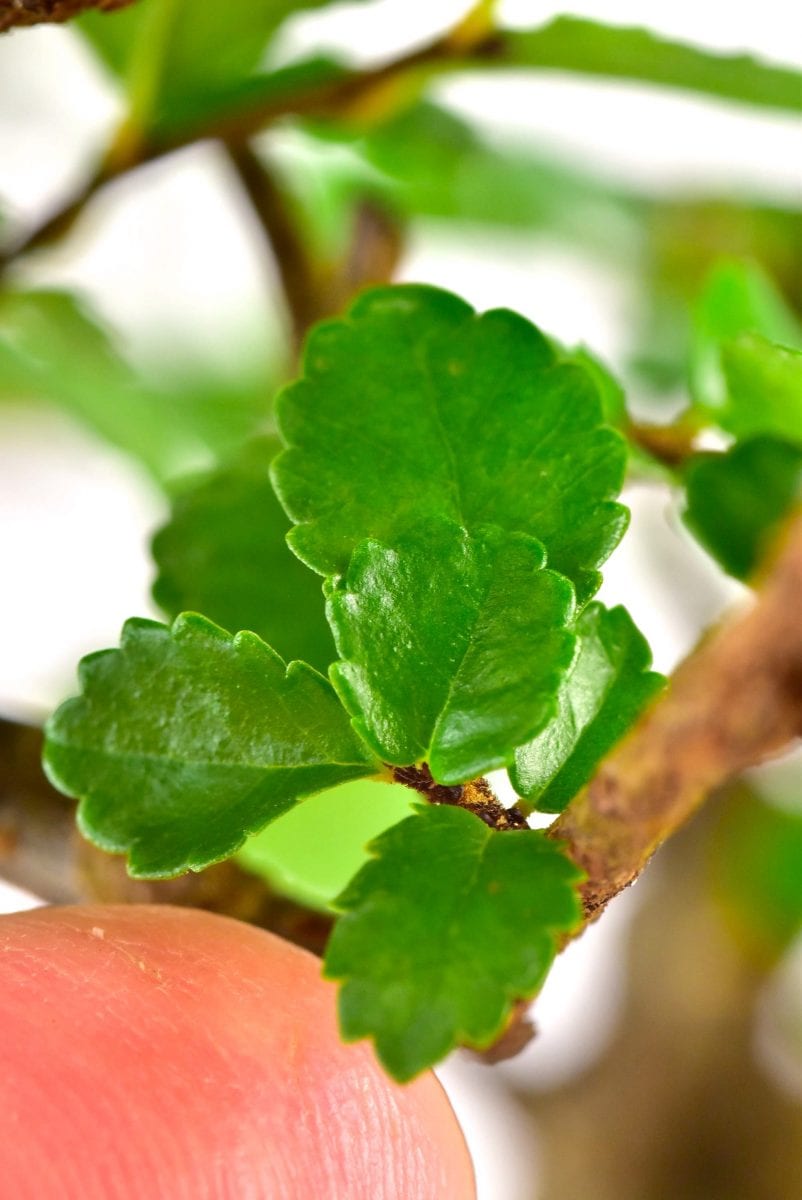
The Chinese Elm (Ulmus parvifolia or Zelkova) is our most popular species of bonsai and we aren’t surprised. This variety is very hardy and can actually live indoors and outdoors (some frost protection is required). As an indoor bonsai, they are evergreen but become deciduous when kept outdoors.
A more traditional looking bonsai, they often display incredible features along their trunks. When looking at the foliage, you will notice the pads display a twiggy structure. Additionally, the leaves are very distinctive with their serrated edges! The foliage pads on these bonsai grow in a neat pattern and show excellent refinement.
The Chinese Elm bonsai symbolises inner strength, intuition, wisdom & love.
Lloyd has sat down to discuss all things Chinese Elm including some care advice. Watch his video here;
Transcription of Video about Basic Care of a Chinese Elm Bonsai Tree
Hi everyone, I’m Lloyd from Bonsai Direct and in this short video I’m going to explain to you the reasons why the Chinese Elm makes such a superb bonsai. So what does make the Chinese Elm such a fantastic bonsai? There are lots of reasons, actually, but we’ll go over the basics. Firstly, it’s very, very easy to look after. The basics of care are very simple on this one. So what we’ll do is we’ll go over that in a minute.
But the other reason I really love about the Chinese Elm is it’s just this twiggy-ness. It’s fantastic for growing as a bonsai because it’s great at being pruned. It doesn’t mind being pruned. And when we prune it, it sends out these lovely little new shoots like this. All over and it back buds really easily, which is fantastic for growing bonsai because we can grow it in many different sizes. Because of that, we can get lovely shapes and twists and curves. Everything you want from a bonsai really.
The most important aspects of Chinese Elm Bonsai care
So what we’ll do is we’ll talk about the basics, the care, because that’s the important bit. We’ve got to get that bit right. And the two most important parts of that. One is the watering, second is the positioning. So let’s go over the watering. Okay. So let’s water this bonsai. So what we’re going to need is a watering can. And this is the important bit. Water all over. Make sure the surface is nice and wet. Give it a good soaking and then leave it. Let the water soak through. And we keep doing this, until the water drains out the bottom of the pot, through the drainage holes into the drip tray. And the drip tray is important, obviously, because otherwise if you’re keeping it indoors, you’re going to end up with a big puddle of water on your table.
When you water, water evenly.
Now, this one’s draining through quite nicely. Nice big puddle of water in the bottom there. That’s great. I’m just going to give it a little bit more anyway. At this stage, it doesn’t matter. I could put the whole watering can full of water on there, but it will just keep draining through. That way we know the root ball is really wet. Okay, so as soon as you start to see a little puddle underneath the pot, then you know the water’s gone down through the root ball and it’s nice and wet. Brilliant. You can stop there.
Now, if we keep the soil just wet all the time, so it’s nice and wet like this, the tree will start to suffer. The reason being is because the roots will start to decay. They will start to rot basically. Now this could take a period of about ten days to two weeks…. three weeks. And gradually the tree will suffer. So this is the important part. When the soil is nice and wet as it is now, we check it again later. All right, so if we just water this in the morning, you’re just getting ready to go out and the soil is nice and wet. The root ball is wet all the way through. Not just the surface but all the way through.
Do not water if the soil surface is wet to the touch.
When you come home, check it again. If it still feels wet, then don’t water. Just leave it. Check it again in the morning. It still feels wet. Leave it. And we only water again, just as the soil starts to feel. Just drying out. Not dry, but just damp. Okay, so you’re going from wet through to damp. Then, it’s time to water. Once it feels damp; so we don’t let it dry out. That’s a big no no. Okay, so that’s important. So it could be twice a day on a really hot day. You might have to water it twice a day, especially if you’ve got a smaller bonsai like this. All right. It’s going to need a lot more watering. Larger ones, not so much. But that’s the important thing. So you might be twice a day. It might be 2 or 3 times a week, depending on the temperature. Okay.
Positioning your Chinese Elm Bonsai
And the other thing which will help is the location. All right. Because that’s important as well where you put your little Chinese elm. Now, it could be on a windowsill somewhere in the house. It could be on a table that’s near a window. It’s got to have good daylight. It doesn’t have to be really bright. It doesn’t need a conservatory or anything like that. It’s not a fussy tree at all.
Good daylight is essential for all bonsai. It will tolerate lower levels, especially through the winter time. All right. So don’t worry about that. If your room just gets a little bit darker than it would do normally, that’s fine. And if you’ve got a window and it’s just one side, turn the tree around. And this is important because it keeps the the growth nice and even. All right. So it allows the whole tree to get some light.
What else is important to keep the Chinese Elm Bonsai healthy?
So we’ve got watering. We’ve got positioning somewhere. It’s got good daylight. Make sure the soil doesn’t dry out and make sure the soil is not constantly wet. Those are important. What else do we need to know about keeping it healthy? Well, we will need to fertilise to give the tree some food. Okay. Now, this is our own bonsai fertiliser. I use this on all of my bonsai and it’s really good.
It’s got all the necessary ingredients in there, and the instructions are there. We’ve also got a video about how to mix this up and how to use it. So you could watch that as well. And that’s important. That will keep the tree healthy. I use it once a week on my indoor bonsai. Throughout the year, because they’re continually growing I give them the nutrients they need.
Misting your Chinese Elm Bonsai with Foliar Feed
And the other thing which I can do here, I’ll do it on this one here. So this is a like a foliar feed. This is a little spray you’ve got when the trees are inside. Okay. So we’re keeping our bonsai indoors like this one. The humidity is not very good. Obviously you’ve got central heating on the air can get quite dry. So a little puff over, like this and some of this. Now this does three things. One is like I said it creates that humidity around the tree.
So once a day in the evening time something like that. It’s also foliar feed. So it helps keep the leaves nice and healthy. It also helps to deter pests. Things like greenfly for instance, which are everywhere, can’t avoid them. No matter where you are, they will find your bonsai. So that’s good. We do that. That help keeps them nice and healthy. So what else do we need? I’ve got the watering, positioning, and pruning.
Pruning your Chinese Elm Bonsai tree
Pruning is also really important in caring for your bonsai. It doesn’t just help maintain the shape, as here we’ve got these lovely pads you can see. But it also helps in the fact that if we didn’t prune it, it would obviously grow out of shape and you’d have big shoots coming out like this. And what that does is that puts extra stress down here on the roots down below. The bigger it gets up here, the more the roots have got to feed all that. Got to water it all. Got to keep it going. So by keeping it trimmed we’re actually helping it, keep its health.
Use a Sharp Pair of Bonsai Pruning Scissors
Pruning wise you will need a good pair of bonsai scissors. You can use general household scissors, but they’re not very good and they won’t do a good job. Okay, so I do recommend a good pair of bonsai scissors. if you’re just starting out and it’s your first bonsai, you don’t need to splash out on something like this. You can just have a pair of these. Okay. Now we do these.
And I think there are only a few pounds, so they’re not overly expensive. They are worth buying. Until, you know, you think, well, “I’m going to do it for a few years”. “I’m going to splash out and put one on your birthday list. Get some bigger ones”. But these are great, actually. They’re sharp and they’re pointy, so I can still get in there and I can go down in and I can do a bit of pruning in there. So they work surprisingly well.
Why do we need to Prune Bonsai?
Pruning wise, what we’re trying to do, especially when you’re first starting out, is maintain the shape and to stop it growing out of shape and getting too long and too leggy. So if you can see this one, I’ll take my scissors and I just prune back in between the foliage. Now I’m trying to, follow a basic rule of thumb, you’re pruning the new shoots. Back to the first pair of leaves on the new shoot, and the new shoot will be bright green. Okay, so that’s very easy. Now, I’ve got one here.
So what I’ll do, I’ll come in close. Now, you see this one here? Okay. So I don’t know if you can see, but it’s bright green. The woody ones are dark brown. Really? Browny colour. Grey colour. So one, two. Cur. Simple as that. That’s all we need to do to start off with. There’s another one here. So coming in there. Okay. Another one here. One, two. Cut. And that’s what we do. And that just maintains the shape. So you’re allowing a couple of new leaves on each little twig to grow. It needs new leaves to photosynthesise. And that will keep the tree nice and healthy. So there we go. That’s just basics. All right.Please Follow us on You-Tube
Enjoy growing your Chinese Elm Bonsai Tree….. or why not gift one!
There are lots more traditional videos on our YouTube channel. And we’re going to keep making lots more as well. So that is the Chinese Elm. The basics, watering, feeding, pruning, & positioning. All those things are really important. And they’re great fun. All right. What else about the Chinese elm that makes it so fantastic? I don’t know, I could go on for ages about it. I love growing the Chinese Elm. I’ve been growing them for well over 30 years, and I’ve grown so many I haven’t got a clue how many. Anyway, so that is it.
I must just say that all our bonsai, by the way, come with an easy to follow care sheet. Okay. That gives you the basic. Goes over what I’ve just talked about. Loads more information on the on our YouTube channel. So if you like this video and I hope you have, and I’ve hoped it’s helped you think about taking on a Chinese Elm as a bonsai.Or maybe first one for somebody else that, you know, that’s that might love growing them. So I hope you liked this video. I hope it helped and I hope to see you again soon. Thanks a lot. Take care.
Please keep in touch!
An eco-friendly bonsai tree from a small, independent UK business who are conscious about their sustainability and are helping to fight the fight for clean air.
If you are unsure about which bonsai tree is best for you, for your gift, or you have any other queries, please contact us and one of our friendly team will get back to you.
Make sure you sign up for our newsletter (at the bottom of the page). You will gain priority access to new products and exclusive offers. You can also find us on Facebook, Instagram, Twitter, TikTok and Pinterest for behind the scenes, tutorials and lots of other care advice!


0 replies