


5-Year-Old vs 10-Year-Old Bonsai: Why Are Some Bonsai So Expensive?
Why can one bonsai cost £30 while another of the same species costs £300, £500 or considerably more? Furthermore, if two bonsai trees are both 30cm tall, why might one be worth several times the price of the other?
The answer lies in something that measurements alone cannot show.
A quality bonsai is not simply a small tree planted in a ceramic pot. Instead, it is a living piece of art, developed gradually through years of growing, pruning, wiring, feeding, repotting, watering and careful decision-making.
Compare a young 5-year-old bonsai with a beautifully developed 10, 15 or 20-year-old specimen and the difference can be remarkable. Surprisingly, the older tree may not actually be much taller. However, its trunk thickness, taper, branch structure, ramification, bark and overall proportions can give it completely different stature.
So, what really changes as a bonsai matures? More importantly, why are the most beautiful mature and specimen bonsai trees more expensive?
Let’s take a closer look.
5-Year-Old vs 10-Year-Old Bonsai: What’s the Difference?
Age alone never tells the whole story.
A beautifully cultivated 10-year-old bonsai can be considerably better than a poorly developed tree twice its age. Therefore, what matters is not simply how long the tree has been alive, but what has happened during those years.
A typical younger bonsai may have:
- A relatively slender trunk
- Simpler primary branching
- Less trunk and branch taper
- A younger, smoother appearance
- Less secondary and tertiary branching
- A less developed canopy
- Fewer mature characteristics
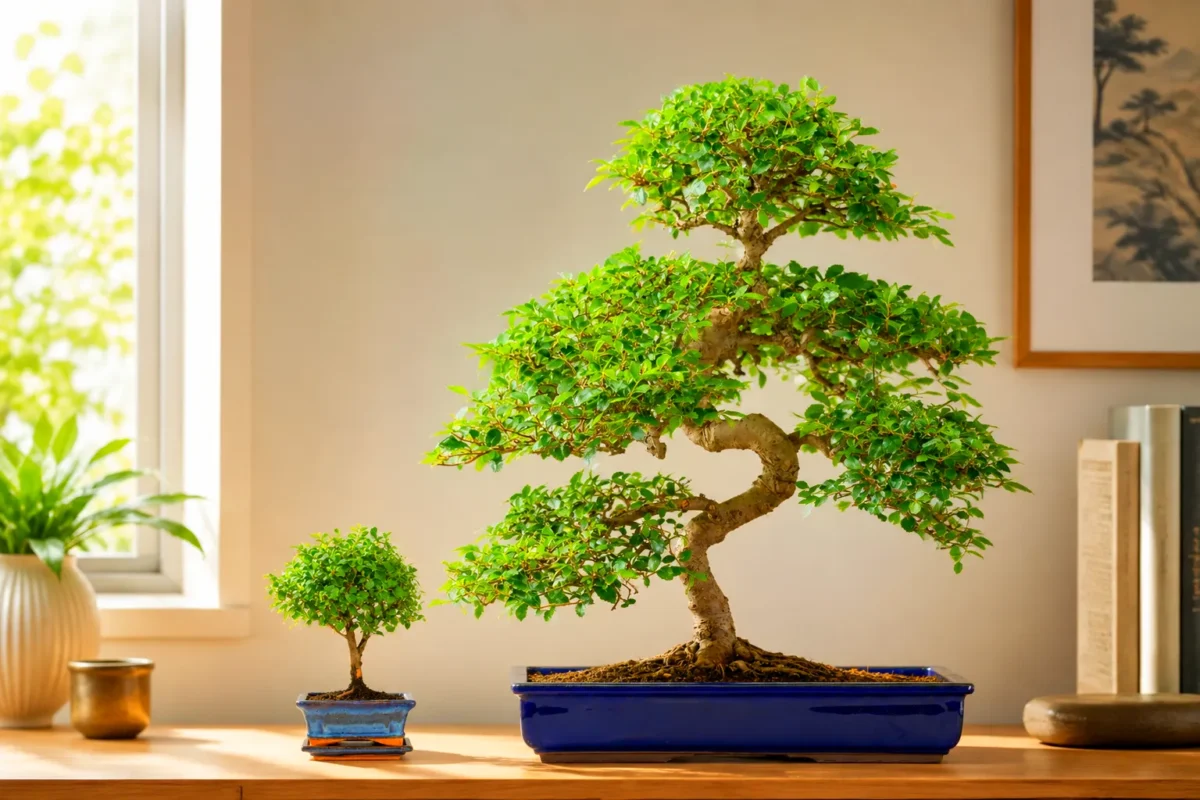
A photograph to show two different indoor bonsai. A Chinese Sweet Plum (Sageretia theezans) on the left which is 7 years old and a Chinese Elm (Ulmus parvifolia) on the right which is over 30 years old. Both bonsai have been professionally grown by Bonsai Direct.
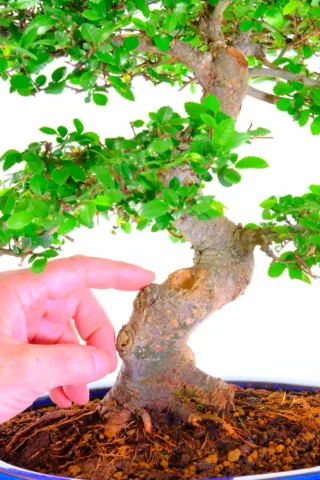
This is a mature specimen indoor bonsai with powerful, character trunk and feature uro.
In comparison, a well-developed older bonsai may have:
- A substantially thicker trunk
- More convincing trunk taper
- Mature primary branches
- Secondary and tertiary branching
- Fine twiggy growth
- Greater ramification
- More mature bark
- Better-defined foliage pads
- A more convincing overall silhouette
Above all, these characteristics take time to develop. You simply cannot make a 5-year-old tree look like a beautifully cultivated 15-year-old specimen in an afternoon.
Height Is Only One Part of the Story
This is one of the most important things to understand when comparing bonsai.
Imagine two Chinese Elm bonsai standing side by side. Both are exactly 30cm tall.
One has a slender trunk and relatively simple branches. In contrast, the other has a substantial tapering trunk, mature bark and a network of increasingly fine branches.
On a website, both could technically be described as a “30cm Chinese Elm Bonsai”. In reality, however, their stature would be completely different.
The slender tree may resemble a young sapling. Meanwhile, the more developed bonsai can create the illusion of an ancient tree reduced to miniature scale.
For this reason, we would never judge the quality of a bonsai by height alone.
Trunk Thickness Creates Stature
One of the first features your eye notices on an impressive bonsai is often the trunk.
A substantial trunk immediately gives a tree visual weight and presence.
For example, compare a 1cm trunk with a 4cm trunk beneath a similarly sized canopy. The overall effect is completely different. A thicker trunk can make the bonsai appear dramatically older and more established.
Developing this thickness takes time.
During the early stages of bonsai cultivation, growers may deliberately allow a tree to grow strongly so the trunk increases in diameter. Later, once the tree moves into a relatively small bonsai pot and its growth becomes more controlled, substantial increases in trunk thickness happen much more slowly.
Consequently, a mature thick trunk can represent years of development before the detailed refinement of the canopy has even begun.
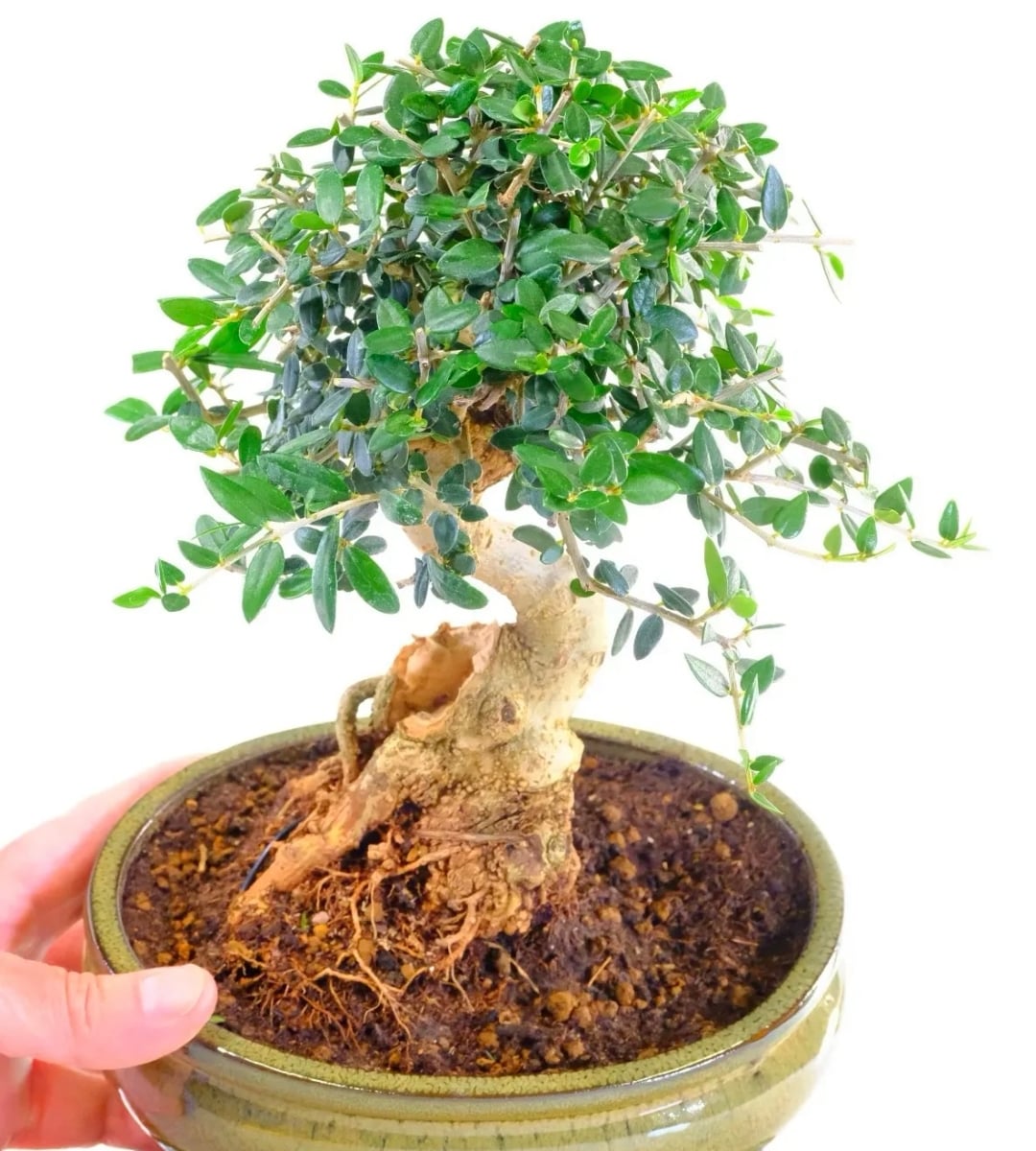
Photo: Olea europaea Olive Bonsai Tree with amazing feature nearby and excellent trunk taper.
Trunk Taper: The Detail You Notice Without Realising
Thickness alone does not make a beautiful bonsai. The trunk should also have convincing taper.
Look at a mature tree in nature. Generally, its trunk is broadest towards the ground and becomes progressively finer as it rises towards the crown.
Bonsai growers try to recreate this same visual effect in miniature.
A trunk that remains almost exactly the same diameter from bottom to top can look cylindrical and youthful. In contrast, a trunk that gradually narrows as it rises creates a much more convincing impression of maturity.
Developing good taper can take years of selective growth and pruning. For instance, a grower may allow particular leaders or branches to grow strongly to thicken one section of the trunk. Later, they can reduce or remove that growth once it has achieved its purpose.
This is a wonderful example of why bonsai cannot be rushed. Sometimes, part of a tree is deliberately allowed to look less refined today because doing so will produce a much better bonsai several years from now.
Branches Need Taper Too
The same principle continues into the branches.
On a beautifully refined bonsai, the transition from trunk to branch and eventually to twig should become progressively finer.
A substantial lower branch may divide into smaller secondary branches. In turn, those branches divide again into tertiary growth. Eventually, they finish in the delicate twiggy structure at the outside of the canopy.
This hierarchy is enormously important because it helps maintain the illusion of scale.
If a bonsai has a substantial trunk but every branch is equally thick, the composition can lose some of its refinement. By comparison, the best mature bonsai have a sense of proportion running through the entire structure.
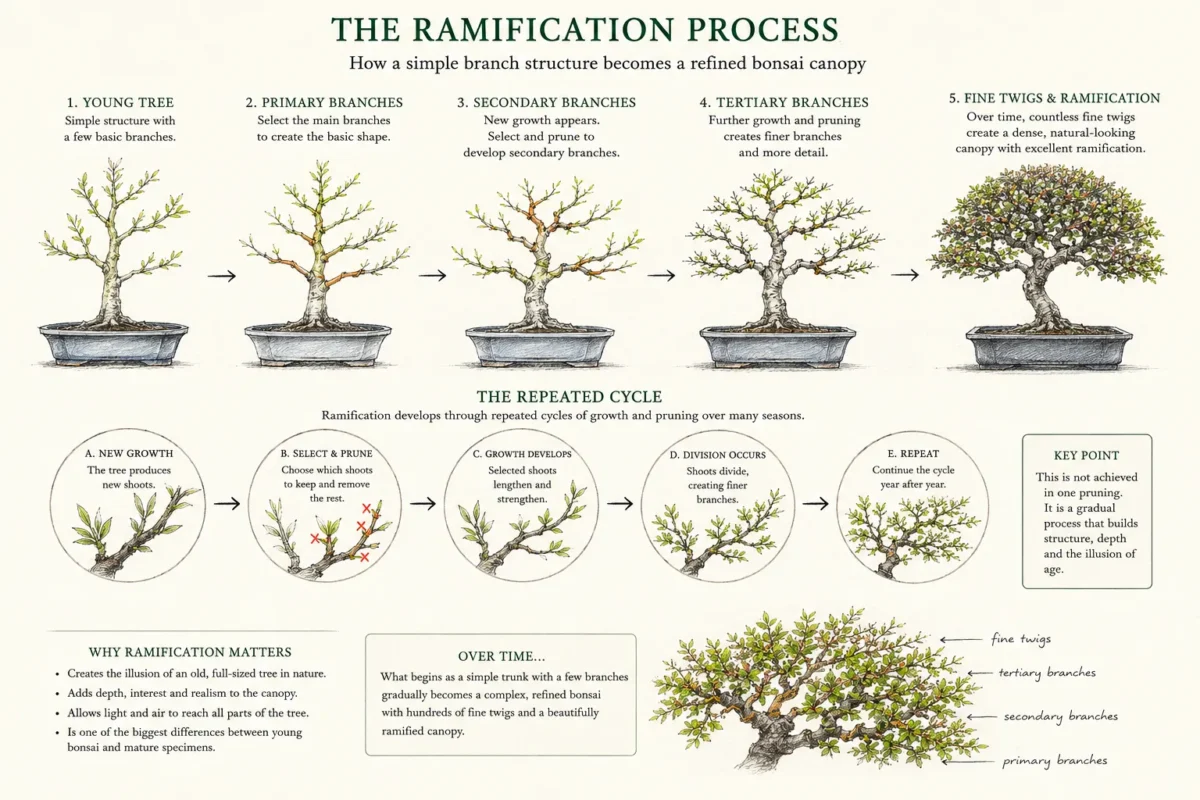
What Is Ramification in Bonsai?
Ramification is one of the most important differences between a young bonsai and a mature specimen.
Quite simply, ramification describes the increasingly fine division of the branches:
Trunk → primary branches → secondary branches → tertiary branches → fine twigs.
As carefully selected growth divides again, the branch structure becomes increasingly intricate. Eventually, hundreds of fine twigs can create the sophisticated canopy we associate with a mature tree.
Importantly, this doesn’t happen through one hard prune.
Instead, ramification develops through repeated cycles of growth and careful pruning. First, the tree produces new shoots. The bonsai grower then decides which growth to retain and which to remove. Afterwards, selected shoots develop further and divide again.
Repeat that process year after year and something wonderful begins to happen. Gradually, the bonsai develops a miniature version of the complex branch structure found in an old tree in nature.
Look Beneath the Leaves
When choosing a mature bonsai, don’t judge it purely by how full and leafy it appears.
Instead, look through the foliage and examine the tree underneath.
A young bonsai can have masses of leaves and look wonderfully full, particularly during summer. Nevertheless, dense foliage doesn’t necessarily indicate a highly developed tree.
Examine the primary branches first. Then notice whether they divide into secondary and tertiary growth. Fine twiggy structure is another excellent sign of refinement, while defined spaces between branches and foliage pads can make the entire design easier to appreciate.
A quality mature bonsai should remain interesting even when much of its foliage is absent.
This becomes particularly obvious with deciduous bonsai during winter. Once the leaves have fallen, the underlying branch structure is completely exposed.
Mature Bark Cannot Be Rushed
Bark is another characteristic that can transform as a bonsai ages. However, the exact changes vary enormously between species.
Some trees develop flaky bark, while others become corky, fissured, silvery or beautifully textured. Furthermore, subtle changes in colour and surface texture can make a trunk appear considerably older.
Chinese Elm, Cork Bark Elm, Pine, Olive, Serissa and many other species can develop increasingly interesting trunk characteristics as they mature.
Unlike foliage, you cannot simply grow a new layer of mature-looking bark in a season.
Time creates it.
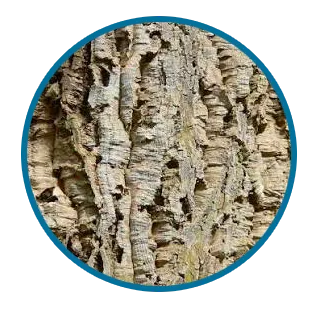
This image shows a magnified sample of cork bark from a Cork Bark Oak Bonsai tree grown by Lloyd Noall from Bonsai Direct
Why a Large Bonsai Is Not Simply a Tall Bonsai
People searching for a large bonsai understandably tend to look at height first. However, height is only one part of the equation.
For example, a 60cm tree with a very slender trunk may still look young. Meanwhile, a beautifully proportioned 35cm bonsai with a substantial tapering trunk can look monumental.
A quality large bonsai needs sufficient visual strength to support its dimensions. Therefore, the trunk, branches and canopy all need to work together.
This explains why some of the most impressive big bonsai aren’t necessarily exceptionally tall. Instead, their proportions create the illusion of scale.
Think of a photograph of a mature oak without anything beside it for reference. You instinctively recognise it as an enormous tree because of its trunk, branches, bark and proportions.
Bonsai uses many of those same visual clues to trick the eye.
Large Bonsai Can Have Extraordinary Presence
There is something very special about a genuinely large, mature bonsai.
A big bonsai can become the focal point of a room, conservatory, patio or garden display. Rather than appearing simply as a decorative plant, it has presence.
A substantial trunk combined with mature branch structure and a broad canopy can create an immediate impression.
For this reason, large bonsai are particularly popular as statement pieces and important gifts. A beautifully developed mature bonsai can feel much closer to acquiring a piece of living sculpture than buying a conventional houseplant.
Why Are Bonsai Trees So Expensive?
When people first encounter an expensive bonsai, it is tempting to assume that the price relates mainly to age.
In reality, you are paying for time, development, horticultural skill and artistic quality.
Imagine what goes into producing a bonsai over ten or twenty years. Throughout that period, someone needs to water and feed the tree correctly, protect it when necessary and monitor its health.
In addition, the tree may undergo repeated pruning, wiring, root pruning and repotting. The grower must continually assess new shoots, remove unwanted branches and decide which growth to retain. Meanwhile, wire needs monitoring and removing before it begins to mark the bark.
Once the basic structure develops, the canopy requires increasingly careful refinement. Then the process continues through another growing season – and another.
A mature bonsai can therefore represent thousands of individual horticultural decisions.
That is one of the principal reasons expensive bonsai cost more. Ultimately, you are buying time that cannot be replaced.
Some of the Work Is Almost Invisible
One of the most fascinating aspects of bonsai is that the better the work becomes, the less obvious some of it appears.
A beautifully positioned branch should eventually look as though it simply grew there. Likewise, good pruning should help the tree appear natural rather than heavily worked.
A flowing trunk may represent years of careful training. Similarly, fine ramification can result from countless small pruning decisions made over many growing seasons.
The objective isn’t necessarily to show how much work the grower has done. Instead, all that work should eventually contribute to a tree that looks beautifully natural.
A Bonsai Grower Sometimes Works Years Ahead
Growing a quality bonsai requires an unusual mindset because the best decision today may not produce a visible improvement for several years.
For example, a branch might deliberately be allowed to grow long because it needs to thicken. Elsewhere, a leader may remain temporarily because it will improve the taper of the trunk.
Similarly, a developing tree may stay in a larger training pot because increasing trunk thickness is more important at that stage than presentation.
Only once that phase is complete does refinement become the priority.
Therefore, bonsai growers constantly balance how a tree looks today with how they hope it will look several years into the future.
Why Cheap Bonsai Aren’t Necessarily Bad Bonsai
A cheaper young bonsai is not necessarily a poor-quality tree. Often, it is simply at an earlier stage of development.
In fact, a young bonsai can be the perfect choice for someone who wants to learn. You can practise pruning, watch the trunk develop, choose branches and gradually put more of your own personality into the design.
The real distinction lies in what you are buying.
With a young bonsai, you are primarily buying potential. A mature bonsai, however, combines that continuing potential with years of development that have already taken place.
Both can be enormously rewarding.
Why More Mature Bonsai Can Be Easier for Beginners
People sometimes assume that beginners should always buy the youngest and cheapest bonsai available. We don’t necessarily agree.
A healthy, established bonsai can actually be more forgiving.
One practical advantage is pot size. Young bonsai and saplings are often grown in very small containers holding relatively little compost. Consequently, they can dry surprisingly quickly during warm weather.
A larger, mature bonsai will generally sit in a larger pot containing a greater volume of compost. Therefore, there is usually a larger reservoir of moisture available to the roots.
Of course, every bonsai still needs regular checking. Importantly, checking does not mean automatically watering. However, tiny trees in very small pots may need particularly close attention during warm weather because moisture levels can change rapidly.
A mature tree also has a more established structure and root system. As a result, a healthy mature specimen can actually be a very enjoyable introduction to bonsai.
Mature Bonsai May Display Features Young Trees Cannot
Age can also bring characteristics that you wouldn’t normally expect from a very young tree.
Fruit is a good example.
At our nursery, we find that Chinese Sweet Plum (Sageretia theezans) and Olive (Olea europaea) generally need to reach a certain level of maturity before you are likely to enjoy their fruit.
Very young specimens rarely fruit reliably. In our experience, trees from around eight years old onwards are much more likely to display fruit when growing conditions are suitable.
Of course, this doesn’t mean every eight-year-old bonsai will automatically fruit. Flowering, pollination, growing conditions and individual vigour all influence the result.
Nevertheless, greater maturity significantly increases the possibility of enjoying these additional characteristics.
What Is a Specimen Bonsai?
You will sometimes see exceptional trees described as specimen bonsai. Importantly, this should mean much more than simply “old”.
A specimen bonsai is an individual tree of particularly noteworthy quality.
Perhaps it has an exceptional trunk or outstanding movement. Alternatively, the tree may display beautiful taper, wonderfully mature bark or highly developed ramification. In other cases, it is the balance of the entire canopy that makes the bonsai special.
Often, it is a combination of many features that gives a specimen tree its extraordinary presence.
Think of it as the bonsai equivalent of choosing an original artwork rather than selecting something purely by dimensions.
Its individuality is part of its value.

Two Bonsai of the Same Age Can Have Very Different Values
Imagine two 15-year-old Chinese Elms.
Tree A has spent most of its life simply growing. Although perfectly healthy, its trunk is relatively straight, its branches remain coarse and little work has gone into refining the structure.
Tree B has spent those same 15 years being deliberately cultivated as a bonsai. Its trunk displays movement and taper, while carefully selected primary branches divide into increasingly fine secondary and tertiary growth. Over time, the canopy has also received repeated refinement.
Both trees are the same species and the same age. They could even be exactly the same height.
Yet their quality – and therefore their value – could be completely different.
Age is an indicator of potential maturity, not a guarantee of artistic quality.
The Pot Becomes Part of the Artwork
As a bonsai matures, its pot becomes increasingly important too.
A bonsai pot isn’t simply a container. Its shape, depth, glaze, colour and proportions can completely change the appearance of the tree above it.
For example, a powerful tree might suit a strong rectangular pot. In contrast, a softer and more graceful bonsai can look beautiful in an oval container.
Colour matters too. A carefully selected glaze might complement autumn foliage, contrast with fresh green leaves or highlight subtle tones within the bark.
When a mature bonsai is paired with the right ceramic pot, the two elements begin to work together as a single composition.
This is another reason we think of specimen bonsai as living art.
The Years Behind a Mature Bonsai
When you look at a beautiful 15-year-old bonsai, try to imagine its history.
Over fifteen springs and summers, the tree may have received thousands of waterings and years of carefully balanced feeding. During that time, it will have experienced periods of vigorous growth followed by repeated pruning and refinement.
Branches will have been selected, while others were removed. Wire may have been applied and later taken off. Meanwhile, several repottings and periods of root management may have taken place.
Inevitably, ideas evolve too. A branch that once seemed important might eventually be removed as the design improves.
Throughout every stage, someone has also had to keep the tree healthy.
That history has value because no manufacturing process can reproduce it instantly.
Bonsai Is Slow Art
Most things we buy today are designed to be produced quickly. Bonsai is the opposite.
Nature dictates the timetable.
Excellent light, appropriate watering and good nutrition can encourage healthy development. Skilled growers can also use sophisticated horticultural techniques to influence growth.
However, nobody can ask a branch to become ten years more mature by next Tuesday.
Some stages simply require another growing season. Then, quite often, they require another one after that.
Patience isn’t merely helpful in bonsai. It is part of the process.
A Mature Bonsai Is Still Not Finished
Buying a mature bonsai doesn’t mean somebody else has already had all the enjoyment of growing it. Quite the opposite.
One of the wonderful principles of bonsai is that a tree is never truly finished.
Even an exceptional specimen continues to change. Fresh shoots emerge, branches thicken and fine twigs multiply. At the same time, bark matures and the canopy continues to evolve.
Eventually, a branch that looks perfect today may become too heavy for the design and need replacing. Alternatively, you may refine the silhouette, improve individual foliage pads or subtly alter the direction of a branch.
Unlike a painting or sculpture, bonsai never reaches a point when the artist puts down the tools forever.
It is living art.
Products by Category
-

Characteristic Flowering Indoor Carmona Bonsai with Exquisite Root Design
£199.99 -
Absolutely Phenomenal Indoor Ficus Bonsai Tree | Banyan Tree
£350.00 -
Exquisite Indoor Ficus Bonsai Tree | Banyan Tree
£550.00 -
Picturesque Flowering Twisty Serissa Bonsai with Sweeping Twisty Trunk – A Personal Favourite
£150.00 -
Incredible Formal Upright Chinese Elm Bonsai | Ideal for Beginners
£265.00 -
Extra Large Ulmus parvifolia Cork Bark Chinese Elm Bonsai | 28-Year-Old Master-Styled Specimen
Price range: £1,500.00 through £1,515.00 -
Captivating Ficus Retusa Indoor Bonsai: Spectacular Powerful Twisty Design
£350.00 -
Best Beginners Bonsai – Chinese Elm Bonsai Tree | Creative Design with Impressive Styling
£750.00 -
Dazzling Large Fukien Tea Bonsai with Dainty White Flowers in Summer
Original price was: £250.00.£150.00Current price is: £150.00. -
Exceptional Dwarf Money Tree Jade Bonsai – Tree of Luck & Prosperity
£350.00 -

Beautifully Designed Specimen Chinese Elm Bonsai with Refined Shaping
£375.00 -
Magnificent Aromatic Pepper Tree Bonsai | Citrus Fragrance & Feature Shari
£450.00 -
Huge Specimen Chinese Elm Indoor Bonsai for Beginners | 30 years old
£985.00 -
Specimen Cork Bark Chinese Elm Bonsai | Premium 24 Year Old Tree
£595.00 -
Specimen Quality Ficus Bonsai Tree – 18-Year-Old Timeless Beauty
£385.00 -
Incredible Chinese Elm Bonsai Tree | Neat, Commanding & Impressive Stature – Top Quality Bonsai
£550.00 -
Stupendous Indoor Ficus Bonsai Tree with Breath-Taking Root Styling
£450.00 -
17-Year-Old Specimen Elm Bonsai Tree | Slanting Style with Shari
£450.00 -
Exquisite 27-Year-Old Specimen Chinese Elm Indoor Bonsai – A Sensational Symbol of Beauty
£699.99 -

Ultimate 46-Year-Old Big Cork Bark Elm Bonsai Tree – Premium Ulmus parvifolia Masterpiece Styled by Expert Artist
£1,750.00 -
Phenomenal 30 year Extra-Large Statement Indoor Specimen Chinese Elm Bonsai – Outstanding!
£750.00 -
Captivating Extra-Large Indoor Chinese Elm Bonsai with Phenomenal Root Exposure | Excellence Range
Price range: £1,350.00 through £1,365.00 -
Spectacular Indoor Ficus Bonsai Tree with Outstanding Root Flare (Nebari)
£499.99 -
Exquisite Specimen Indoor Ficus Bonsai Tree with Beautiful Styling in Contemporary Ceramic Pot
£385.00 -
Incredible Chinese Elm Bonsai Tree | Neat, Commanding Presence & Twisting Stature
£495.00
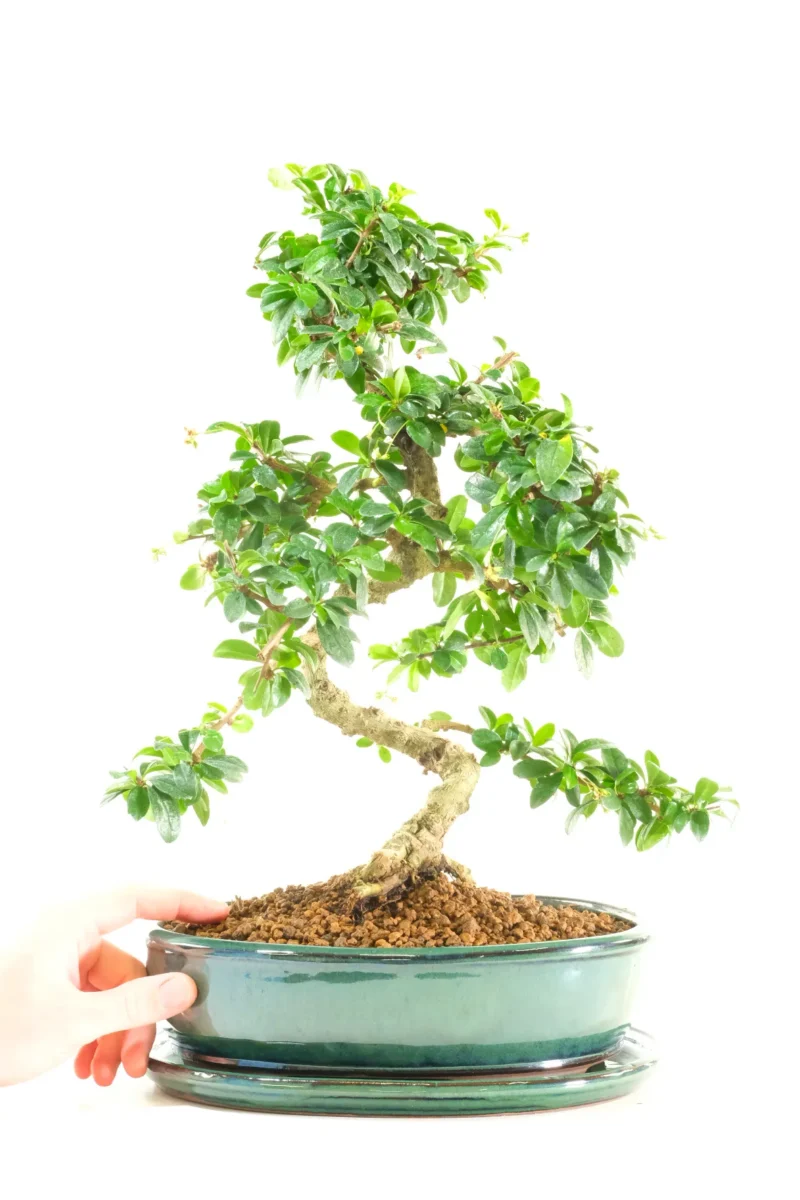
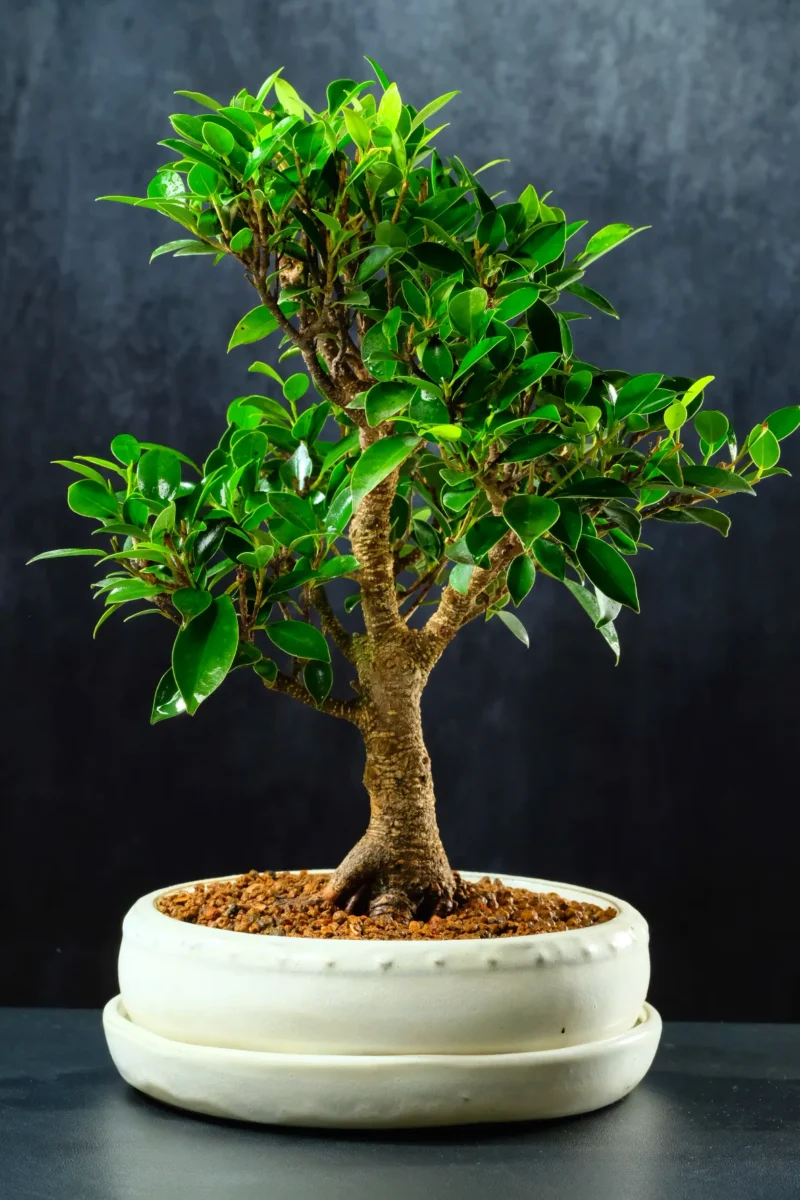
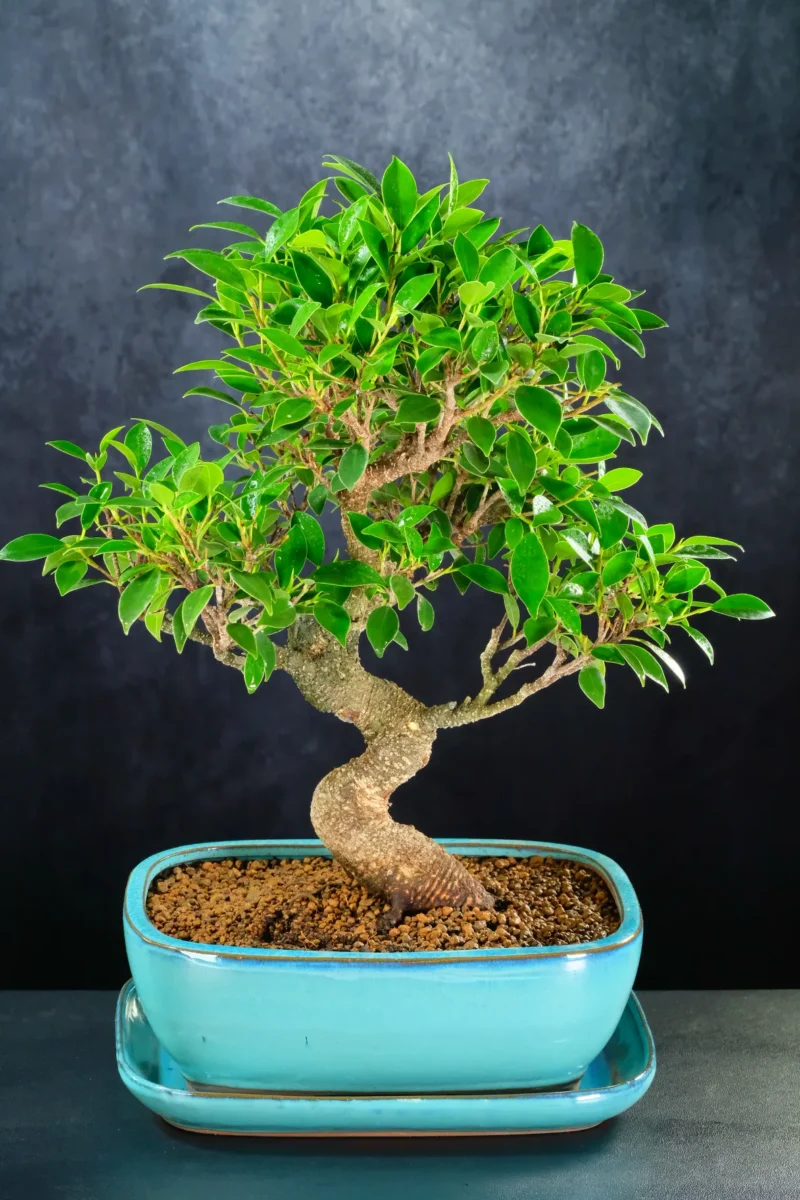
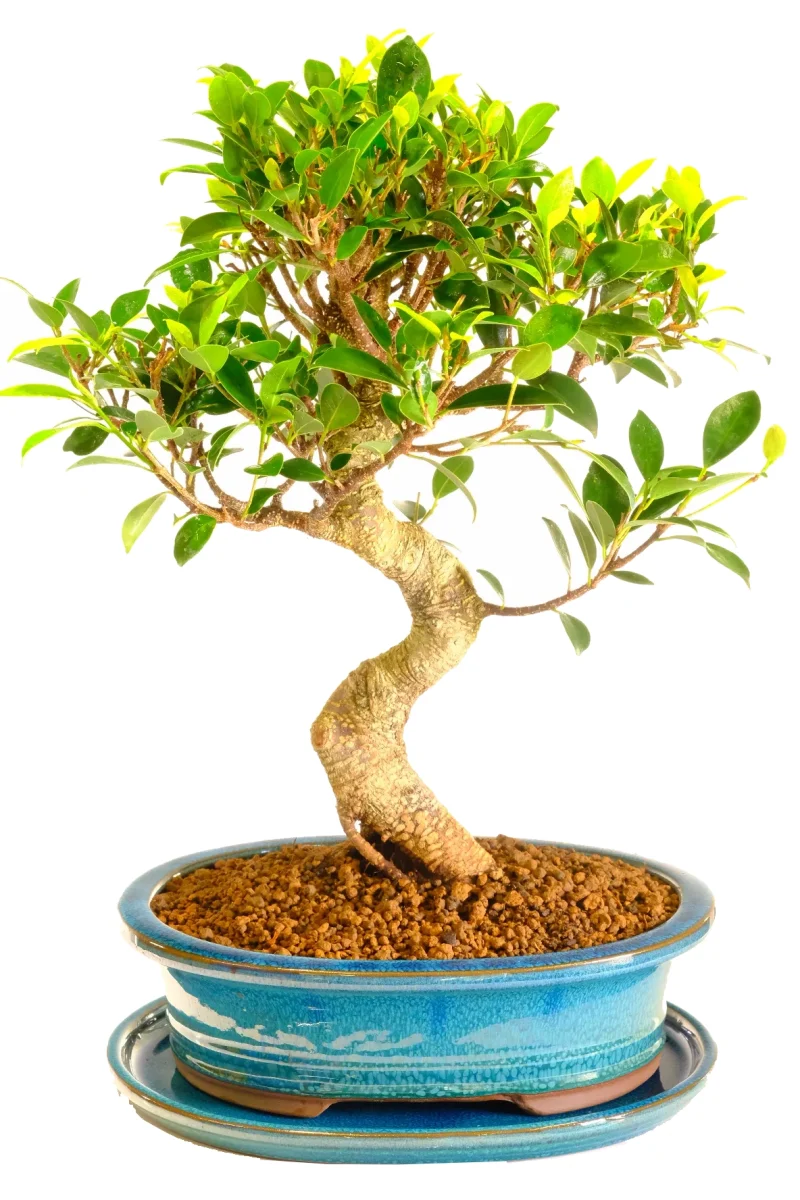
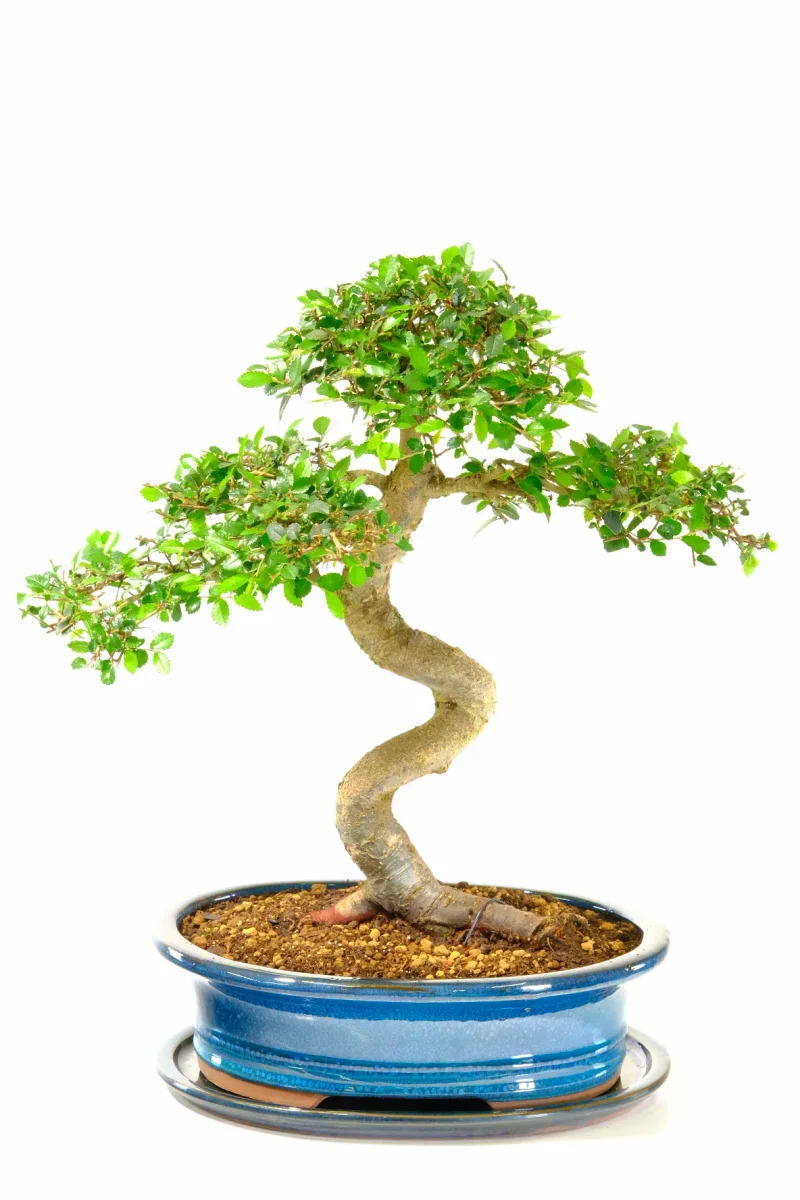
Buying a Mature Bonsai Means Becoming Its Next Custodian
We particularly like this way of thinking about mature bonsai.
Rather than buying the end of the story, you become part of its next chapter.
Someone may have spent the previous ten or twenty years developing the tree. From that point onwards, you have the pleasure of caring for it and influencing what happens next.
With the right care, a bonsai can continue developing for decades. Indeed, some bonsai considerably outlive the people who originally created them.
Consequently, mature bonsai have a very different emotional quality from most things we purchase.
Should I Buy a 5-Year-Old or 10-Year-Old Bonsai?
There is no single correct answer because both offer different experiences.
A younger bonsai could be ideal if you:
- Have a smaller budget
- Want to learn pruning and styling
- Enjoy watching a tree develop
- Want to influence more of its future design
- Like the idea of growing alongside your bonsai
By comparison, consider a more mature bonsai if you:
- Want greater immediate impact
- Appreciate thicker trunks and mature character
- Would like more developed ramification
- Are looking for a statement piece
- Prefer a more established tree
- Are buying an important gift
- Appreciate bonsai as living art
Finally, if you are looking for something truly exceptional, an individually selected specimen bonsai may offer the character and individuality you are searching for.
What Should You Look for When Buying an Expensive Bonsai?
If you are considering investing in a more expensive bonsai, don’t simply compare age and height. Instead, take time to study the individual tree.
Begin with the trunk. Ideally, it should have character, pleasing movement and convincing taper. Next, consider its proportions and whether the trunk feels substantial enough for the height of the tree.
From there, follow the branches outwards. Mature branches should gradually become finer, eventually developing into delicate twiggy growth. Inside the canopy, good ramification adds complexity and helps create the impression of a full-sized tree in miniature.
Mature bark can provide another clue to development, although its appearance will vary between species. Meanwhile, the overall silhouette should feel balanced rather than awkward or top-heavy.
Finally, consider the pot. The best combinations allow the pot and tree to complement one another without either competing for attention.
Then consider something much harder to measure: how does the tree make you feel?
The finest specimen bonsai have presence. You find yourself studying the trunk, following individual branches and discovering details that weren’t immediately obvious.
That individuality is difficult to capture in a simple list of measurements.
Is an Expensive Bonsai Worth It?
That depends entirely on what you want from your bonsai.
If your greatest pleasure comes from taking a young tree and spending years developing it yourself, a younger bonsai may provide far more enjoyment for your money.
On the other hand, if you appreciate mature trees, beautiful proportions, complex ramification and the extraordinary amount of time involved in creating them, a specimen bonsai can be something very special.
You aren’t simply paying for a bigger plant. Instead, you are paying for the years already invested in its development.
5 Years vs 10 Years: You’re Really Buying Time
Ultimately, the difference between a 5-year-old and 10-year-old bonsai is not simply five birthdays.
Those additional years can represent thousands of waterings and countless decisions. During five extra growing seasons, the trunk has more time to thicken and the bark can begin to mature.
Meanwhile, repeated cycles of pruning and regrowth can create secondary and tertiary branches. Taper can improve, the canopy can become more refined and the entire composition can gradually mature.
Perhaps most importantly, those extra years represent someone’s continued care.
That is why a quality mature bonsai can command a significantly higher price than a young tree.
The Real Value of a Bonsai
Perhaps we should stop thinking about bonsai in quite the same way as ordinary plants.
A 50cm houseplant is generally bigger than a 30cm houseplant, so naturally we expect it to cost more.
Bonsai doesn’t work like that.
A smaller bonsai may have taken considerably longer to produce than a taller one. For instance, a 30cm specimen with an exceptional trunk and intricate ramification could represent far more years of skilled work than a relatively young 60cm tree.
Therefore, the real value lies in the quality of the material, maturity of its characteristics, horticultural work and artistry of the overall composition.
Height certainly matters, as do age and species. However, none of these factors tells the whole story on its own.
Every Bonsai Still Has a Future
Whether you choose an affordable 5-year-old tree, a beautiful 10-year-old bonsai, a large bonsai or an exceptional specimen, perhaps the most important thing to remember is that you are buying something alive.
Your bonsai will never look exactly as it does today again.
Fresh shoots will emerge and, in time, you will prune them. Branches will continue developing, while the trunk and bark gradually mature. Eventually, you might even choose a completely different ceramic pot as the tree’s character changes.
Years from now, you can look back at the photograph taken on the day you bought your bonsai and see just how far it has developed.
That is the magic of bonsai.
A mature bonsai may already represent years of patience, knowledge, skilled cultivation and artistic work. Yet it is never a completely finished piece of art.
The next part of its story belongs to you.
Related Content
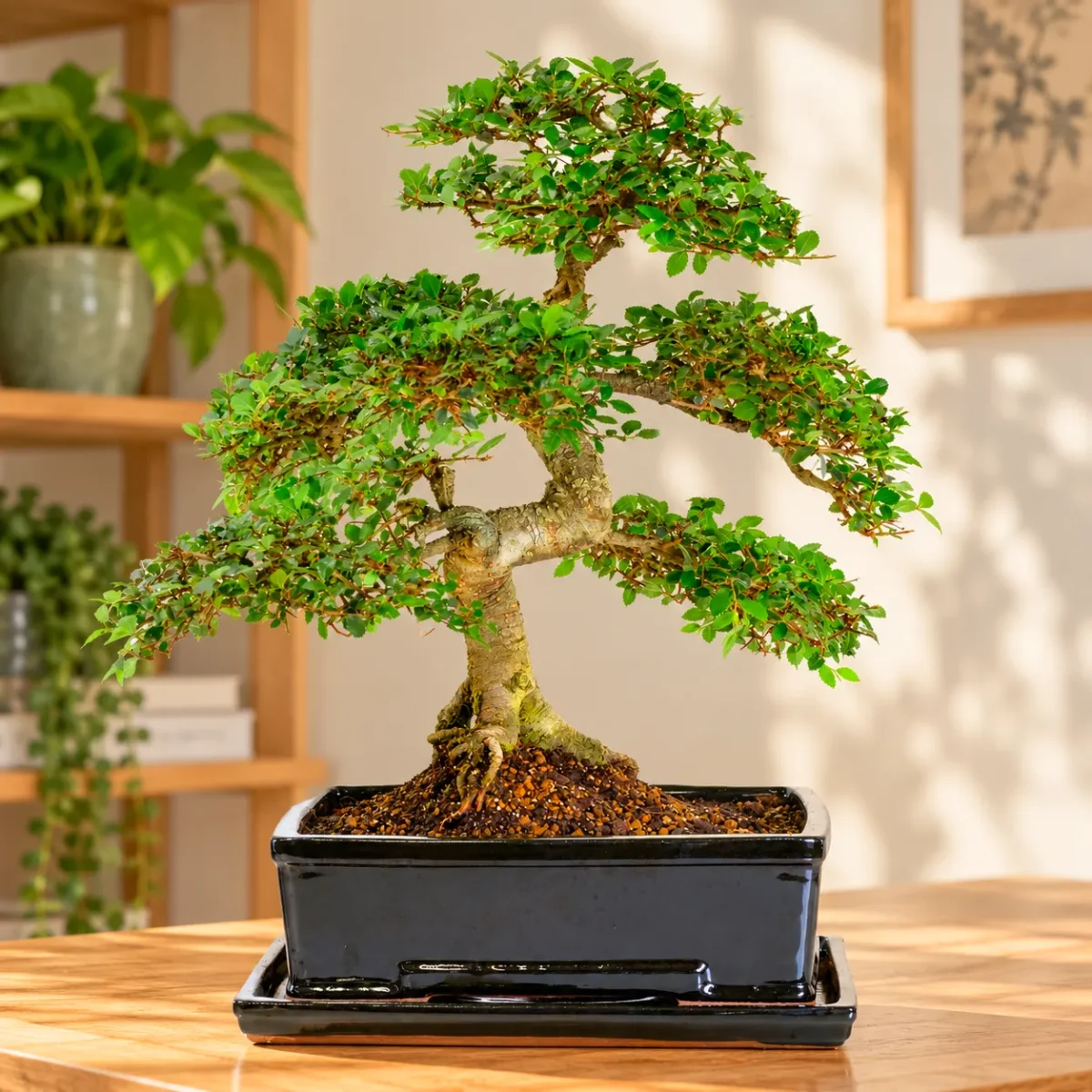
What We Look for When Choosing a Bonsai for Our Premium Collection
Ever wondered what makes one bonsai stand out from thousands of others? Discover how we select trees for our Premium Bonsai Collection, from exceptional trunks, taper and nebari…
Read More
Why We Grow Our Own Bonsai Trees
Discover why we grow bonsai trees at our Bonsai Direct Devon nursery, from unusual species to better trunks, branching and quality that develops over many years.
Read More
Bonsai: The Complete Beginner’s Guide
Discover the fascinating world of bonsai with our complete beginner's guide. Drawing on around 40 years of commercial growing experience, we explain what a bonsai tree is, how…
Read More

Celebrate 20 Years of Bonsai Direct with Our Biggest Ever Anniversary Sale!
Celebrate Bonsai Direct's 20th Anniversary with our biggest-ever sale! Enjoy exclusive savings on selected bonsai trees, plus free UK delivery to most addresses and bonus gifts. Shop limited-time…
Read More
Bonsai Direct’s 20th Anniversary Celebration Starts 3rd July
Bonsai Direct's 20th Anniversary event, with freebies, giveaways, sales, and exclusive deals.
Read More
Something Big Is Growing at Bonsai Direct…
Join us for our 20th Anniersary celabrations, including a TikTok megalive, discounts, freebies, offers, website sales, and more.
Read More
Celebrating World Bonsai Day 2026
Celebrate World Bonsai Day on 9th May 2026. Discover why it matters and join Bonsai Direct’s TikTok Live on 8th May for exclusive trees, flash sales, and special…
Read More